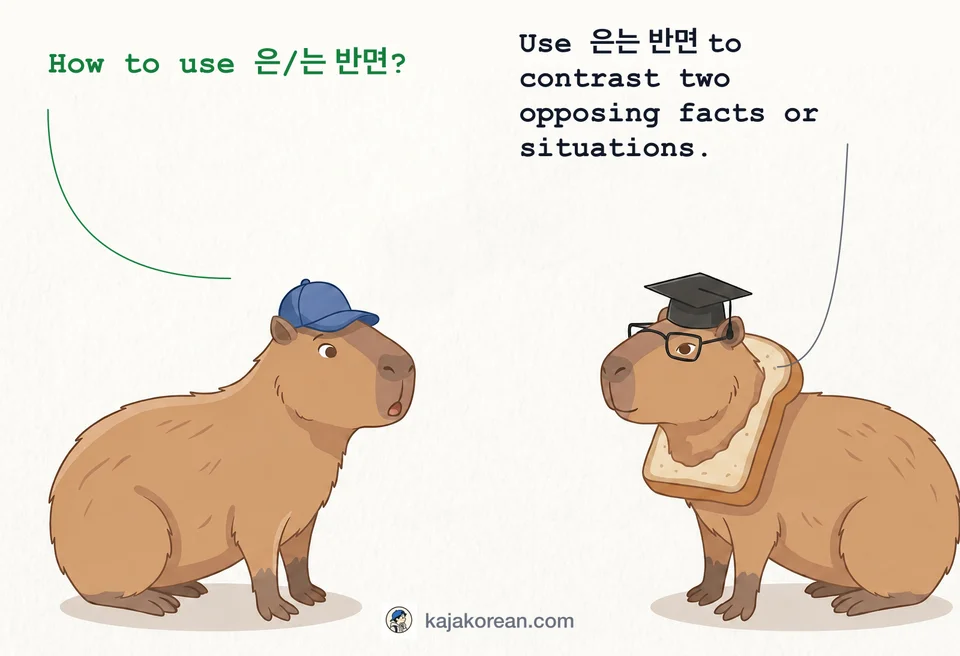
How to use 은/는 반면 in Korean

Pattern: -(으)ㄴ/는 반면

-(으)ㄴ/는 반면 (-(eu)ㄴ, (eu)ㄴ, neunban-myeon, neunbanmyeon)

-(으)ㄴ/는 반면 is used to contrast two opposing facts or situations. Learn this for natural contrasting expressions.

Contrast usage of 은는 반면 in Korean grammar

Usage guide

When and how native speakers actually use it.

-(으)ㄴ/는 반면(-(eu)ㄴ, (eu)ㄴ, neunban-myeon, neunbanmyeon)

A connective ending used to compare two contrasting facts or situations

When to use

contrasting statements, comparative explanations, opposing opinions

The nuance

Attach -(으)ㄴ 반면 to past tense verbs or adjectives, and -는 반면 to present tense verbs. It connects two contrasting clauses where the second clause differs or opposes the first.

Real-world examples

  • 그는 열심히 일하는 반면 친구는 게으르다.

    geu-neun yeol-sim-hi il-ha-neun ban-myeon chin-gu-neun ge-eu-reu-da., geu neun yeol sim hi il ha neun ban myeon chin gu neun ge eu reu da.

    Clearly shows contrasting situations between two subjects.

  • 이 제품은 가격이 싸는 반면 품질이 좋다.

    i je-pum-eun ga-gyeok-i ssa-neun ban-myeon pum-jil-i joh-da., i je pum eun ga gyeok i ssa neun ban myeon pum jil i joh da.

    Incorrect form '싸는'; correct is '싼 반면'.

  • 그녀는 친절한 반면 남편은 무뚝뚝하다.

    geu-nyeo-neun chin-jeol-han ban-myeon nam-pyeon-eun mu-ttuk-ttuk-ha-da., geu nyeo neun chin jeol han ban myeon nam pyeon eun mu ttuk ttuk ha da.

    Correctly attaches -(으)ㄴ 반면 to adjectives.

  • 나는 운동을 좋아하는 반면 동생은 책 읽는 걸 좋아한다.

    na-neun un-dong-eul joh-a-ha-neun ban-myeon dong-saeng-eun chaek ik-neun geol joh-a-han-da., na neun un dong eul joh a ha neun ban myeon dong saeng eun chaek ik neun geol joh a han da.

    Uses -는 반면 with present tense verbs properly for contrast.

  • 그는 부지런한 반면, 나는 게으르다.

    geu-neun bu-ji-reon-han ban-myeon, na-neun ge-eu-reu-da., geu neun bu ji reon han ban myeon, na neun ge eu reu da.

    Attaches -(으)ㄴ 반면 to adjective and contrasts two clauses.

  • 비가 오는 반면, 바람도 많이 분다.

    bi-ga o-neun ban-myeon, ba-ram-do man-i bun-da., bi ga o neun ban myeon, ba ram do man i bun da.

    Uses -는 반면 with present progressive verbs correctly.

Quick quiz

  1. Which sentence correctly uses -(으)ㄴ/는 반면?

    다음 중 -(으)ㄴ/는 반면을 올바르게 사용한 문장은?(da-eumjung-(eu)ㄴ, daeumjung(eu)ㄴ, neunban-myeon-eulol-ba-reu-gesa-yong-hanmun-jang-eun?, neunbanmyeoneulolbareugesayonghanmunjangeun?)
  2. When do you use -(으)ㄴ/는 반면?

    -(으)ㄴ/는 반면은 어떤 상황에서 사용하나요?(-(eu)ㄴ, (eu)ㄴ, neunban-myeon-euneo-tteonsang-hwang-e-seosa-yong-ha-na-yo?, neunbanmyeoneuneotteonsanghwangeseosayonghanayo?)
  3. Fill in the blank: 그는 열심히 일하는 ______ 친구는 게으르다.

    다음 문장에서 빈칸에 들어갈 말은? 그는 열심히 일하는 ______ 친구는 게으르다.(da-eummun-jang-e-seobin-kan-edeul-eo-galmal-eun?geu-neunyeol-sim-hiil-ha-neun______chin-gu-neunge-eu-reu-da., daeummunjangeseobinkanedeuleogalmaleun?geuneunyeolsimhiilhaneun______chinguneungeeureuda.)

More usage guides

View all usage guides →