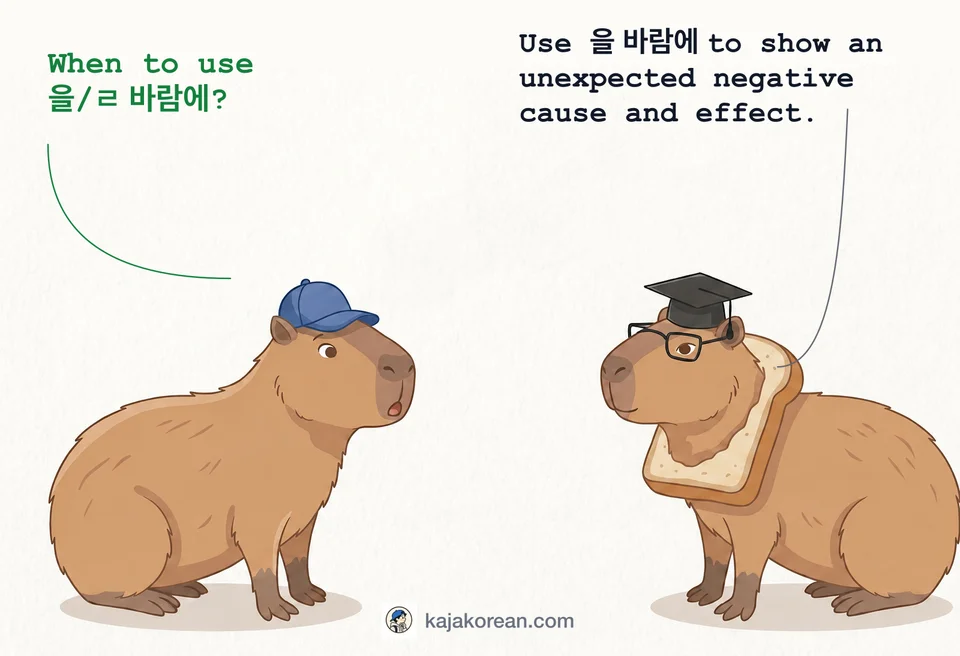
How to use 을/ㄹ 바람에 in Korean

Pattern: -(으)ㄹ 바람에

-(으)ㄹ 바람에 (-(eu)ㄹba-ram-e, (eu)ㄹbarame)

-(으)ㄹ 바람에 expresses unexpected negative results caused by an action or event.

Explanation of Korean grammar pattern 을 바람에

Usage guide

When and how native speakers actually use it.

-(으)ㄹ 바람에(-(eu)ㄹba-ram-e, (eu)ㄹbarame)

Indicates a negative or unwanted outcome caused by an action or event

When to use

Explaining unexpected negative results, Emphasizing cause of an event, Expressing regret or frustration

The nuance

Attach -(으)ㄹ 바람에 to the verb stem to explain the cause of an unexpected negative result. It can refer to past or future events, and the following clause usually describes the negative outcome.

Real-world examples

  • 길이 막힐 바람에 약속에 늦었어요.

    gil-i mak-hil ba-ram-e yak-sok-e neuj-eoss-eo-yo., gil i mak hil ba ram e yak sok e neuj eoss eo yo.

    Clearly shows the traffic jam caused the unexpected negative result of being late.

  • 비가 올 바람에 소풍이 취소되었어요.

    bi-ga ol ba-ram-e so-pung-i chwi-so-doe-eoss-eo-yo., bi ga ol ba ram e so pung i chwi so doe eoss eo yo.

    Rain caused the negative outcome of picnic cancellation appropriately.

  • 너무 피곤할 바람에 회의에 집중하지 못했어요.

    neo-mu pi-gon-hal ba-ram-e hoe-ui-e jip-jung-ha-ji mos-haess-eo-yo., neo mu pi gon hal ba ram e hoe ui e jip jung ha ji mos haess eo yo.

    Tiredness suitably explains the negative result of not focusing.

  • 친구를 만날 바람에 숙제를 못 했어요.

    chin-gu-reul man-nal ba-ram-e suk-je-reul mos haess-eo-yo., chin gu reul man nal ba ram e suk je reul mos haess eo yo.

    Meeting a friend naturally connects as cause of not doing homework.

  • 시험 공부를 열심히 할 바람에 좋은 점수를 받았어요.

    si-heom gong-bu-reul yeol-sim-hi hal ba-ram-e joh-eun jeom-su-reul bat-ass-eo-yo., si heom gong bu reul yeol sim hi hal ba ram e joh eun jeom su reul bat ass eo yo.

    Pattern expresses negative results, so using it with positive outcome is incorrect.

  • 차가 고장날 바람에 여행이 망쳤어요.

    cha-ga go-jang-nal ba-ram-e yeo-haeng-i mang-chyeoss-eo-yo., cha ga go jang nal ba ram e yeo haeng i mang chyeoss eo yo.

    Car breakdown appropriately causes the negative result of ruined trip.

  • 늦게 출발할 바람에 비행기를 놓쳤어요.

    neuj-ge chul-bal-hal ba-ram-e bi-haeng-gi-reul noh-chyeoss-eo-yo., neuj ge chul bal hal ba ram e bi haeng gi reul noh chyeoss eo yo.

    Leaving late explains the negative outcome of missing the plane.

Quick quiz

  1. Which sentence correctly uses -(으)ㄹ 바람에?

    -(으)ㄹ 바람에를 사용해야 하는 문장은?(-(eu)ㄹba-ram-e-reulsa-yong-hae-yaha-neunmun-jang-eun?, (eu)ㄹbaramereulsayonghaeyahaneunmunjangeun?)
  2. Which usage is incorrect?

    다음 중 틀린 사용은?(da-eumjungteul-rinsa-yong-eun?, daeumjungteulrinsayongeun?)
  3. What meaning does -(으)ㄹ 바람에 express?

    -(으)ㄹ 바람에가 나타내는 의미는?(-(eu)ㄹba-ram-e-gana-ta-nae-neunui-mi-neun?, (eu)ㄹbarameganatanaeneunuimineun?)

More usage guides

View all usage guides →