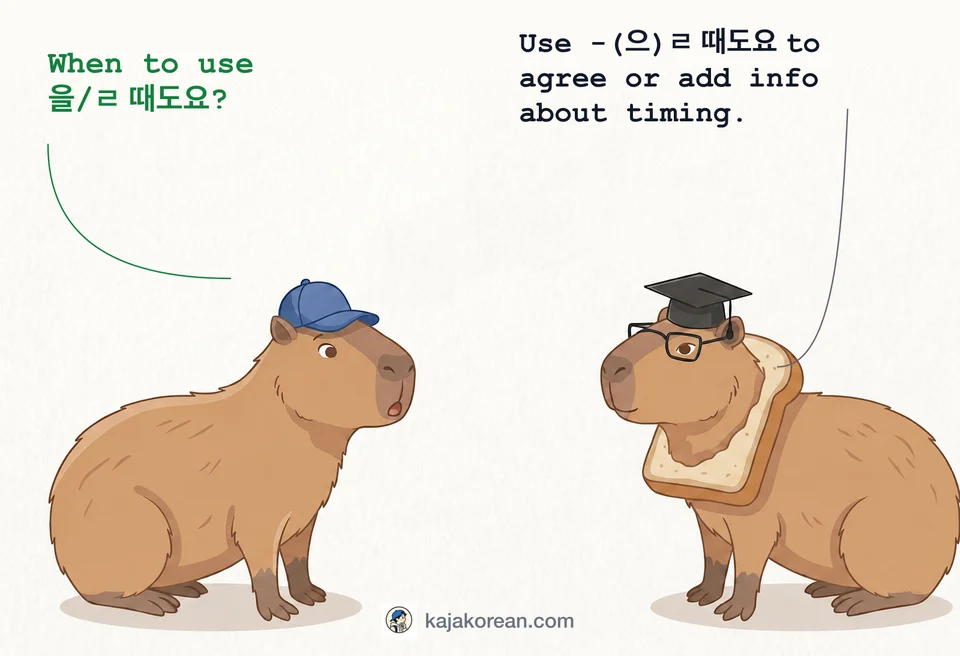
How to use 을/ㄹ 때도요 in Korean

Pattern: -(으)ㄹ 때도요

-(으)ㄹ 때도요 (-(eu)ㄹttae-do-yo, (eu)ㄹttaedoyo)

-(으)ㄹ 때도요 emphasizes timing and agrees or adds info in conversations.

Explanation of Korean grammar -(으)ㄹ 때도요

Usage guide

When and how native speakers actually use it.

-(으)ㄹ 때도요(-(eu)ㄹttae-do-yo, (eu)ㄹttaedoyo)

Expresses the time when something happens and agrees or adds to the previous statement.

When to use

agreeing, sharing similar experience, adding information

The nuance

Attach -(으)ㄹ 때 to verb/adjective stems to mean 'when (someone) does something.' Adding 도요 creates ‘~할 때도요,’ which agrees with or adds to the previous statement about timing. Example: “저도 갈 때도요.” means 'I also when I go.'

Real-world examples

  • A: 저는 운동할 때 음악을 들어요. B: 저도 운동할 때도요.

    a: jeo-neun un-dong-hal ttae eum-ak-eul deul-eo-yo. b: jeo-do un-dong-hal ttae-do-yo., a: jeo neun un dong hal ttae eum ak eul deul eo yo. b: jeo do un dong hal ttae do yo.

    It naturally agrees with the other person about the same timing.

  • A: 비가 올 때 우산을 써요. B: 저도 비가 올 때도요.

    a: bi-ga ol ttae u-san-eul sseo-yo. b: jeo-do bi-ga ol ttae-do-yo., a: bi ga ol ttae u san eul sseo yo. b: jeo do bi ga ol ttae do yo.

    It emphasizes agreement on the same action and timing.

  • A: 저는 아플 때 약을 먹어요. B: 저도 아플 때도요.

    a: jeo-neun a-peul ttae yak-eul meok-eo-yo. b: jeo-do a-peul ttae-do-yo., a: jeo neun a peul ttae yak eul meok eo yo. b: jeo do a peul ttae do yo.

    Naturally expresses agreement and similar timing.

Quick quiz

  1. Which sentence correctly uses -(으)ㄹ 때도요?

    다음 중 ‘-(으)ㄹ 때도요’가 올바르게 쓰인 문장은?(da-eumjung‘-(eu)ㄹttae-do-yo’gaol-ba-reu-gesseu-inmun-jang-eun?, daeumjung‘(eu)ㄹttaedoyo’gaolbareugesseuinmunjangeun?)
  2. What is the best meaning of -(으)ㄹ 때도요?

    ‘-(으)ㄹ 때도요’의 의미로 가장 적절한 것은?(‘-(eu)ㄹttae-do-yo’uiui-mi-roga-jangjeok-jeol-hangeos-eun?, ‘(eu)ㄹttaedoyo’uiuimirogajangjeokjeolhangeoseun?)

More usage guides

View all usage guides →