
면(myeon)
Used to express a simple 'if' condition or situation.
When to use
everyday condition, simple hypothetical, immediate result
The nuance
Attach to verb or adjective stems to indicate a simple condition; commonly used in everyday conversation.
면 (myeon) · 다면 (da-myeon, damyeon)
면 expresses simple conditions, while 다면 is used for hypothetical or more formal conditional statements.
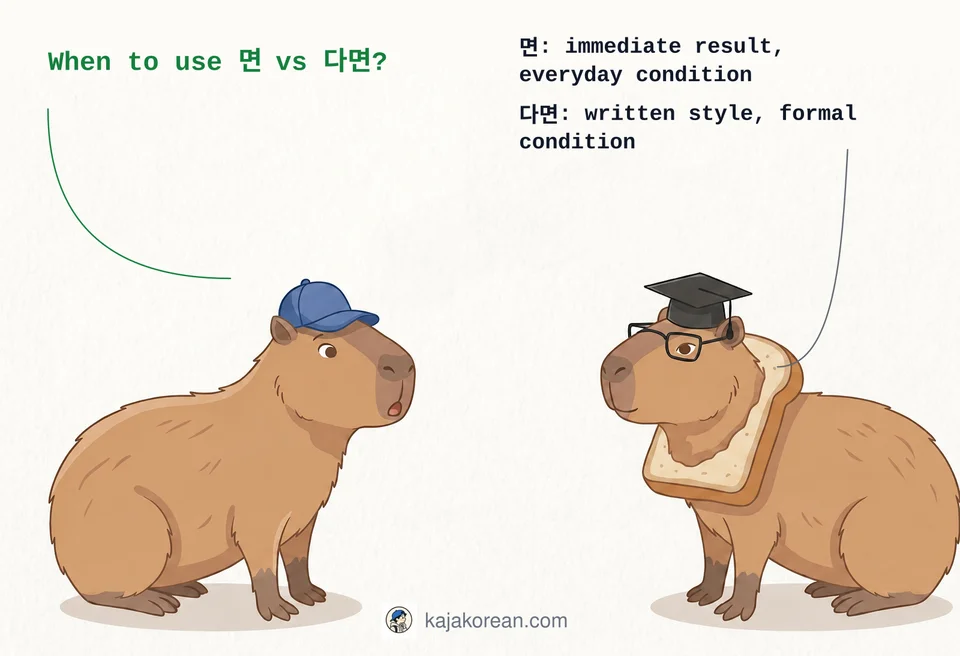
One lane per word — no nested boxes, just the gist.
Used to express a simple 'if' condition or situation.
When to use
everyday condition, simple hypothetical, immediate result
The nuance
Attach to verb or adjective stems to indicate a simple condition; commonly used in everyday conversation.
Used to express a more hypothetical and formal condition, often in written or formal contexts.
When to use
formal condition, hypothetical situation, written style
The nuance
Attach '-다면' to verb or adjective stems to express hypothetical and formal conditions; mainly used in written or formal speech.
비가 오면 집에 있을 거예요.
bi-ga o-myeon jip-e iss-eul geo-ye-yo., bi ga o myeon jip e iss eul geo ye yo.
Used 면 naturally to express a common everyday condition.
비가 오다면 집에 있을 거예요.
bi-ga o-da-myeon jip-e iss-eul geo-ye-yo., bi ga o da myeon jip e iss eul geo ye yo.
Used 다면 to express a more formal and hypothetical condition.
공부하면 시험에 합격할 수 있다.
gong-bu-ha-myeon si-heom-e hap-gyeok-hal su iss-da., gong bu ha myeon si heom e hap gyeok hal su iss da.
Used 면 to clearly express a simple condition and result.
공부다면 시험에 합격할 수 있다.
gong-bu-da-myeon si-heom-e hap-gyeok-hal su iss-da., gong bu da myeon si heom e hap gyeok hal su iss da.
Cannot attach 다면 to '공부다' because it is not a verb stem; must use '공부하다'.
시간이 있으면 같이 가자.
si-gan-i iss-eu-myeon gat-i ga-ja., si gan i iss eu myeon gat i ga ja.
Used 면 naturally for a casual everyday condition.
시간이 있다면 같이 가자.
si-gan-i iss-da-myeon gat-i ga-ja., si gan i iss da myeon gat i ga ja.
Used 다면 to express a more polite and hypothetical condition.
그가 오면 바로 시작하자.
geu-ga o-myeon ba-ro si-jak-ha-ja., geu ga o myeon ba ro si jak ha ja.
Used 면 naturally to express immediate condition and result.
그가 온다면 바로 시작하자.
geu-ga on-da-myeon ba-ro si-jak-ha-ja., geu ga on da myeon ba ro si jak ha ja.
Used 다면 to express a formal and hypothetical condition.
Which expression is used for simple everyday conditions?
Which is used for more formal and hypothetical conditions?
Which is the correct conditional form with '공부한다'?