
어제(eo-je, eoje)
A time expression meaning the day immediately before today
When to use
day before today, daily conversation date reference, event one day ago
The nuance
어제 is used to refer to the day immediately before today, exactly one day ago.
어제 (eo-je, eoje) · 그저께 (geu-jeo-kke, geujeokke)
어제 means 'yesterday' (the day before today), while 그저께 means 'the day before yesterday' (two days before today).
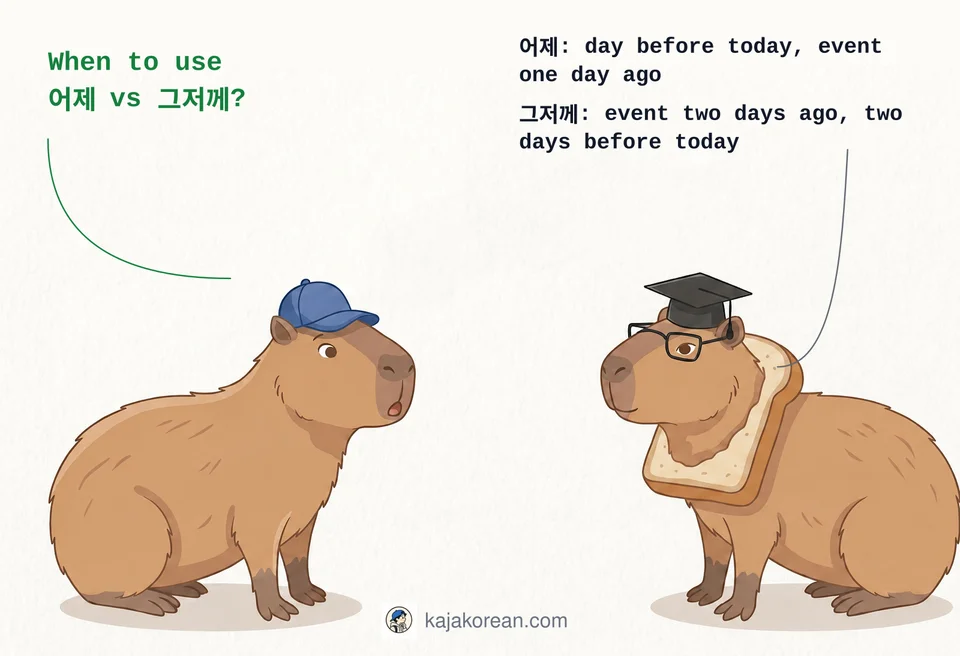
One lane per word — no nested boxes, just the gist.
A time expression meaning the day immediately before today
When to use
day before today, daily conversation date reference, event one day ago
The nuance
어제 is used to refer to the day immediately before today, exactly one day ago.
A time expression meaning two days before today, one day before yesterday
When to use
two days before today, event two days ago, precise date distinction
The nuance
그저께 is used to refer to two days before today, one day before yesterday, distinct from 어제.
어제 친구를 만났어요.
eo-je chin-gu-reul man-nass-eo-yo., eo je chin gu reul man nass eo yo.
Refers to the day before today, so 어제 is correct.
그저께 친구를 만났어요.
geu-jeo-kke chin-gu-reul man-nass-eo-yo., geu jeo kke chin gu reul man nass eo yo.
Means two days before today, so 그저께 is correct.
어제 그저께에 갔어요.
eo-je geu-jeo-kke-e gass-eo-yo., eo je geu jeo kke e gass eo yo.
Combining 어제 and 그저께 is incorrect as they refer to different days.
그저께에 학교에 갔어요.
geu-jeo-kke-e hak-gyo-e gass-eo-yo., geu jeo kke e hak gyo e gass eo yo.
Correctly indicates two days ago.
어제에 학교에 갔어요.
eo-je-e hak-gyo-e gass-eo-yo., eo je e hak gyo e gass eo yo.
'어제' is not used with the particle '에'.
그저께에 비가 왔어요.
geu-jeo-kke-e bi-ga wass-eo-yo., geu jeo kke e bi ga wass eo yo.
'그저께' is generally not used with the particle '에'.
그저께는 날씨가 좋았어요.
geu-jeo-kke-neun nal-ssi-ga joh-ass-eo-yo., geu jeo kke neun nal ssi ga joh ass eo yo.
Natural use of 그저께 as subject without particle.
어제는 바빴어요.
eo-je-neun ba-ppass-eo-yo., eo je neun ba ppass eo yo.
어제 is naturally used as subject without particle.
From today, when does '그저께' refer to?
Which sentence correctly uses '어제'?
Which expression does NOT fit with '그저께'?
What does it mean?