
약속하다(yak-sok-ha-da, yaksokhada)
To make a commitment or promise to do something in the future
When to use
Future action promise, Time appointment, Behavior commitment
The nuance
Used when someone commits to or agrees on a future action.
약속하다 (yak-sok-ha-da, yaksokhada) · 허락하다 (heo-rak-ha-da, heorakhada)
약속하다 means to make a commitment about future actions, while 허락하다 means to grant permission for someone's action.
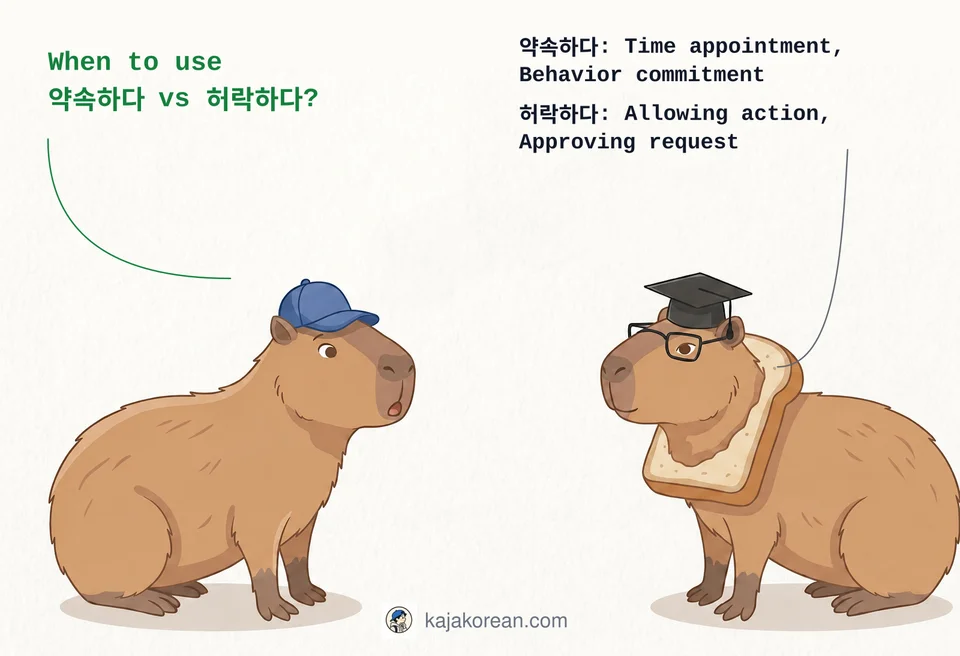
One lane per word — no nested boxes, just the gist.
To make a commitment or promise to do something in the future
When to use
Future action promise, Time appointment, Behavior commitment
The nuance
Used when someone commits to or agrees on a future action.
To allow or approve someone else's action or request
When to use
Allowing action, Approving request, Granting authority
The nuance
Used when granting permission or approval for someone else's action.
나는 친구와 내일 만나기로 약속했어요.
na-neun chin-gu-wa nae-il man-na-gi-ro yak-sok-haess-eo-yo., na neun chin gu wa nae il man na gi ro yak sok haess eo yo.
Appropriate because it is a promise about a future meeting.
나는 부모님께 늦게 자도 되냐고 허락했어요.
na-neun bu-mo-nim-kke neuj-ge ja-do doe-nya-go heo-rak-haess-eo-yo., na neun bu mo nim kke neuj ge ja do doe nya go heo rak haess eo yo.
Incorrect because you must receive permission from parents, not grant it yourself.
선생님이 학생들에게 휴대폰 사용을 허락했다.
seon-saeng-nim-i hak-saeng-deul-e-ge hyu-dae-pon sa-yong-eul heo-rak-haess-da., seon saeng nim i hak saeng deul e ge hyu dae pon sa yong eul heo rak haess da.
Correct as a person in authority permits an action.
나는 친구에게 내일 영화를 보자고 허락했어요.
na-neun chin-gu-e-ge nae-il yeong-hwa-reul bo-ja-go heo-rak-haess-eo-yo., na neun chin gu e ge nae il yeong hwa reul bo ja go heo rak haess eo yo.
Incorrect because you make a promise to watch a movie, not grant permission.
그는 나에게 그 일을 도와주겠다고 약속했다.
geu-neun na-e-ge geu il-eul do-wa-ju-gess-da-go yak-sok-haess-da., geu neun na e ge geu il eul do wa ju gess da go yak sok haess da.
Expresses a promise to help in the future.
엄마가 내가 파티에 가는 것을 약속했다.
eom-ma-ga nae-ga pa-ti-e ga-neun geos-eul yak-sok-haess-da., eom ma ga nae ga pa ti e ga neun geos eul yak sok haess da.
Incorrect because the mother grants permission, not makes a promise.
회사는 직원들에게 휴가를 허락했다.
hoe-sa-neun jik-won-deul-e-ge hyu-ga-reul heo-rak-haess-da., hoe sa neun jik won deul e ge hyu ga reul heo rak haess da.
The company approves employees' vacation, so 허락하다 is correct.
나는 친구와 다음 주에 점심 먹기로 허락했어요.
na-neun chin-gu-wa da-eum ju-e jeom-sim meok-gi-ro heo-rak-haess-eo-yo., na neun chin gu wa da eum ju e jeom sim meok gi ro heo rak haess eo yo.
Having lunch together is a promise, not permission.
I ___ to meet my friend tomorrow.
I got ___ from my parents to stay up late.
The teacher ___ the students to use their phones.
I ___ to study together with my friend next week.