
혼자(hon-ja, honja)
Only one person without others
When to use
Traveling alone, Eating alone, Studying alone
The nuance
혼자 is used when someone is doing something alone, without anyone else present.
혼자 (hon-ja, honja) · 둘이서 (dul-i-seo, duliseo) · 함께 (ham-kke, hamkke)
혼자 is used when doing something alone, 둘이서 refers specifically to two people together, and 함께 is for doing something with others generally.
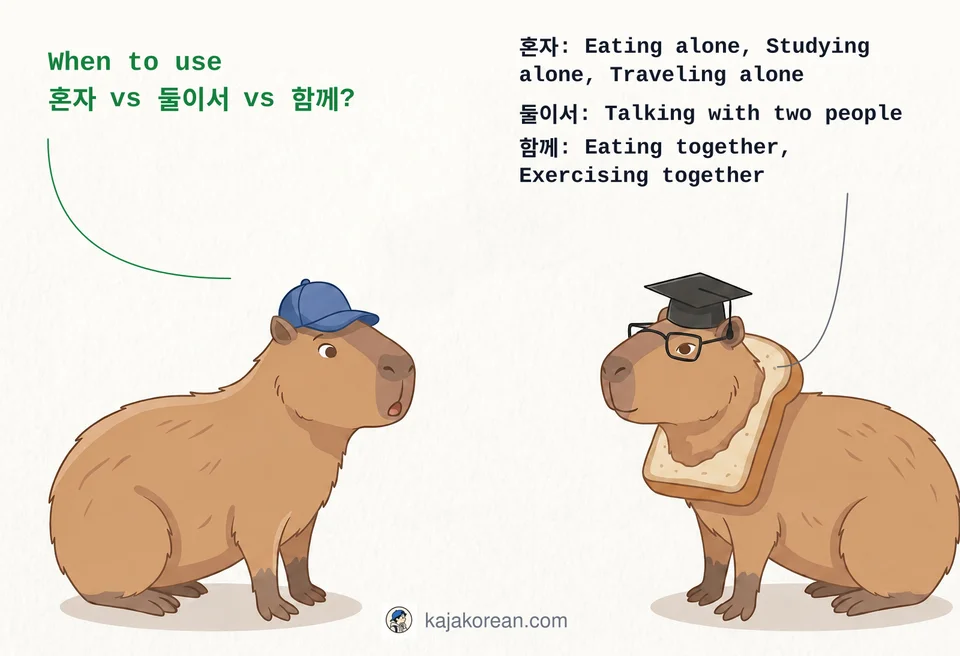
One lane per word — no nested boxes, just the gist.
Only one person without others
When to use
Traveling alone, Eating alone, Studying alone
The nuance
혼자 is used when someone is doing something alone, without anyone else present.
When two people do something together
When to use
Watching a movie with two people, Talking with two people, Playing a game with two people
The nuance
둘이서 is used specifically when exactly two people do something together; it cannot be used for three or more people.
When two or more people do something together, usually more than two
When to use
Eating together, Exercising together, Going on a trip together
The nuance
함께 is used when two or more people do something together, often implying a group including friends or family.
나는 혼자 여행을 갔다.
na-neun hon-ja yeo-haeng-eul gass-da., na neun hon ja yeo haeng eul gass da.
Traveling alone means going by oneself, which is natural with 혼자.
나는 둘이서 여행을 갔다.
na-neun dul-i-seo yeo-haeng-eul gass-da., na neun dul i seo yeo haeng eul gass da.
둘이서 implies two people together, so using '나는' alone is incorrect.
우리는 둘이서 영화를 봤다.
u-ri-neun dul-i-seo yeong-hwa-reul bwass-da., u ri neun dul i seo yeong hwa reul bwass da.
둘이서 fits perfectly when exactly two people watch a movie together.
셋이서 함께 운동했다.
ses-i-seo ham-kke un-dong-haess-da., ses i seo ham kke un dong haess da.
Using 셋이서 and 함께 together is redundant and unnatural.
친구들과 함께 식사를 했다.
chin-gu-deul-gwa ham-kke sik-sa-reul haess-da., chin gu deul gwa ham kke sik sa reul haess da.
함께 suits situations involving multiple people doing something together.
나는 함께 책을 읽었다.
na-neun ham-kke chaek-eul ik-eoss-da., na neun ham kke chaek eul ik eoss da.
함께 requires two or more people, so it doesn't fit with a singular subject like 나는.
둘이서 대화하는 게 편하다.
dul-i-seo dae-hwa-ha-neun ge pyeon-ha-da., dul i seo dae hwa ha neun ge pyeon ha da.
둘이서 clearly indicates an action between two people.
혼자서 밥을 먹었다.
hon-ja-seo bap-eul meok-eoss-da., hon ja seo bap eul meok eoss da.
혼자서 is natural when someone does something alone.
When can you use 둘이서?
Which sentence does not fit with both 혼자 and 함께?
When is 함께 NOT appropriate?