
긍정(geung-jeong, geungjeong)
An attitude of acceptance or seeing something positively
When to use
expressing agreement, positive evaluation, when agreeing with something
The nuance
Use 긍정 when accepting or agreeing with a fact or opinion.
긍정 (geung-jeong, geungjeong) · 부정 (bu-jeong, bujeong) · 중립 (jung-rip, jungrip)
긍정, 부정, and 중립 represent attitudes of acceptance, rejection, or neutrality toward a situation or opinion, respectively.
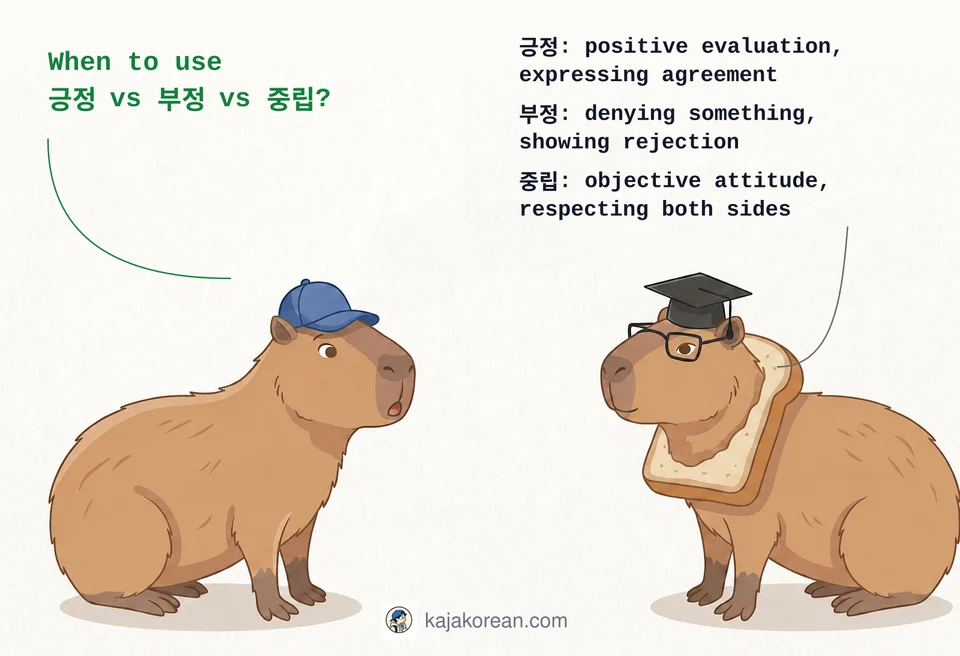
One lane per word — no nested boxes, just the gist.
An attitude of acceptance or seeing something positively
When to use
expressing agreement, positive evaluation, when agreeing with something
The nuance
Use 긍정 when accepting or agreeing with a fact or opinion.
An attitude of rejection or denial toward a situation or opinion
When to use
expressing opposition, denying something, showing rejection
The nuance
Use 부정 when rejecting or opposing a fact or opinion.
An attitude of neutrality, not taking sides or showing clear agreement or disagreement
When to use
no agreement or opposition, objective attitude, respecting both sides
The nuance
Use 중립 when maintaining an objective stance without agreeing or opposing.
나는 그 계획에 긍정한다.
na-neun geu gye-hoek-e geung-jeong-han-da., na neun geu gye hoek e geung jeong han da.
‘긍정하다’ naturally means ‘to agree’ or ‘approve’ here.
나는 그 계획에 부정한다.
na-neun geu gye-hoek-e bu-jeong-han-da., na neun geu gye hoek e bu jeong han da.
‘부정하다’ appropriately means ‘to oppose’ or ‘deny’.
나는 그 계획에 중립한다.
na-neun geu gye-hoek-e jung-rip-han-da., na neun geu gye hoek e jung rip han da.
‘중립하다’ is not used as a verb; say ‘have a neutral attitude’ instead.
그 의견에 부정적인 반응을 보였다.
geu ui-gyeon-e bu-jeong-jeok-in ban-eung-eul bo-yeoss-da., geu ui gyeon e bu jeong jeok in ban eung eul bo yeoss da.
‘부정적’ means ‘negative’ and is natural here.
그 의견에 긍정적인 반응을 보였다.
geu ui-gyeon-e geung-jeong-jeok-in ban-eung-eul bo-yeoss-da., geu ui gyeon e geung jeong jeok in ban eung eul bo yeoss da.
‘긍정적’ means ‘positive’ and fits well.
나는 중립적인 의견을 부정한다.
na-neun jung-rip-jeok-in ui-gyeon-eul bu-jeong-han-da., na neun jung rip jeok in ui gyeon eul bu jeong han da.
Denying a ‘neutral opinion’ is contradictory and incorrect.
그는 중립적인 입장을 취했다.
geu-neun jung-rip-jeok-in ip-jang-eul chwi-haess-da., geu neun jung rip jeok in ip jang eul chwi haess da.
‘Neutral position’ is a natural and correct expression.
When is ‘긍정’ most appropriate?
Which sentence should use ‘부정’?
Which sentence uses ‘중립’ correctly?