Hanja Words vs Native Korean Words vs Loanwords: Mastering Korean Origins

한자어 (han-ja-eo, hanjaeo) · 고유어 (go-yu-eo, goyueo) · 외래어 (oe-rae-eo, oeraeeo)

Hanja words, native Korean words, and loanwords are three main categories of Korean word origins, each with distinct usage and nuances.

Comparison of Korean words: Hanja, native, and loanwords

Word-by-word breakdown

One lane per word — no nested boxes, just the gist.

한자어(han-ja-eo, hanjaeo)

Korean words derived from Chinese characters (Hanja)

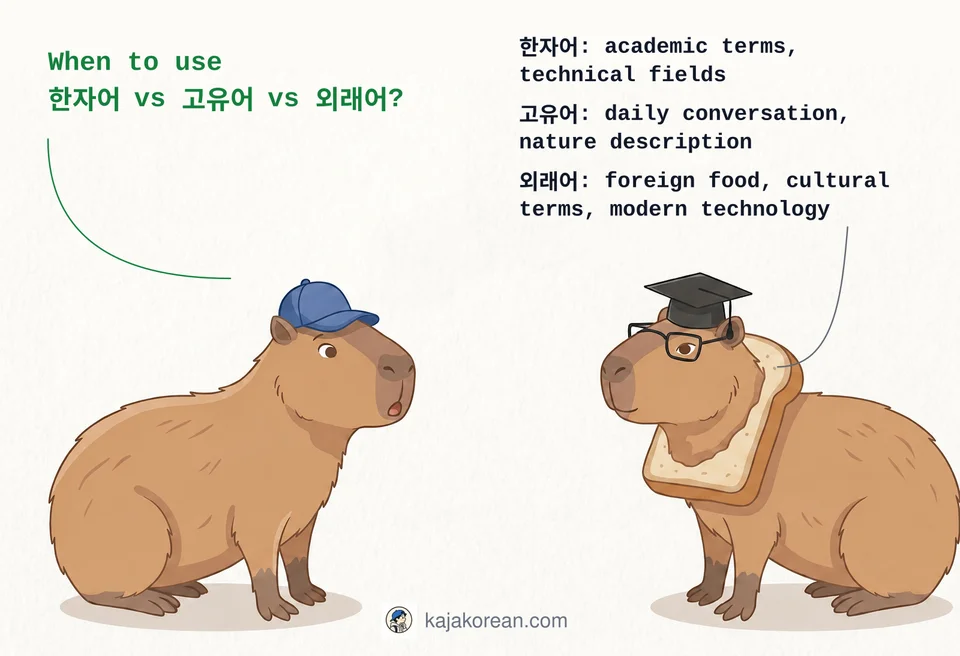
When to use

official documents, academic terms, technical fields

The nuance

Hanja words are mainly used in formal, academic, or technical contexts and often form compound words.

고유어(go-yu-eo, goyueo)

Native Korean words used for everyday life, nature, and emotions

When to use

daily conversation, nature description, emotion expression

The nuance

Native Korean words fit casual conversation and expressions of nature or emotions, giving a friendly, natural feel.

외래어(oe-rae-eo, oeraeeo)

Loanwords from foreign languages, mainly used for modern culture, technology, and food-related new terms

When to use

modern technology, foreign food, cultural terms

The nuance

Loanwords are mainly used to express modern concepts like new technology, foreign food, and culture.

Real-world examples

  • 이 보고서는 한자어가 많이 포함되어 있어 전문적이다.

    i bo-go-seo-neun han-ja-eo-ga man-i po-ham-doe-eo iss-eo jeon-mun-jeok-i-da., i bo go seo neun han ja eo ga man i po ham doe eo iss eo jeon mun jeok i da.

    Using Hanja words in official documents is natural and appropriate.

  • 나는 오늘 밥을 먹었다.

    na-neun o-neul bap-eul meok-eoss-da., na neun o neul bap eul meok eoss da.

    Using the native Korean word '밥' in daily conversation is perfect.

  • 컴퓨터는 한자어이다.

    keom-pyu-teo-neun han-ja-eo-i-da., keom pyu teo neun han ja eo i da.

    '컴퓨터' is a loanword, not a Hanja word; must use loanword category.

  • 바나나는 고유어이다.

    ba-na-na-neun go-yu-eo-i-da., ba na na neun go yu eo i da.

    '바나나' is a loanword, not native Korean.

  • 경제학은 한자어로 만들어진 학문 용어이다.

    gyeong-je-hak-eun han-ja-eo-ro man-deul-eo-jin hak-mun yong-eo-i-da., gyeong je hak eun han ja eo ro man deul eo jin hak mun yong eo i da.

    '경제학' is a Hanja word suitable for academic terminology.

  • 친구와 산책하며 꽃을 봤다.

    chin-gu-wa san-chaek-ha-myeo kkoch-eul bwass-da., chin gu wa san chaek ha myeo kkoch eul bwass da.

    Native words like '산책' and '꽃' fit nature descriptions well.

  • 햄버거는 고유어이다.

    haem-beo-geo-neun go-yu-eo-i-da., haem beo geo neun go yu eo i da.

    '햄버거' is a loanword, not a native Korean word.

  • 스마트폰은 외래어이다.

    seu-ma-teu-pon-eun oe-rae-eo-i-da., seu ma teu pon eun oe rae eo i da.

    '스마트폰' is a loanword from a foreign language.

Quick quiz

  1. Which of the following is NOT a native Korean word?

    다음 중 고유어가 아닌 것은?(da-eumjunggo-yu-eo-gaa-ningeos-eun?, daeumjunggoyueogaaningeoseun?)
  2. What type of word is '경제학'?

    '경제학'은 어떤 종류의 단어인가요?('gyeong-je-hak'euneo-tteonjong-ryu-uidan-eo-in-ga-yo?, 'gyeongjehak'euneotteonjongryuuidaneoingayo?)
  3. What is the origin of '햄버거'?

    '햄버거'는 어떤 어원인가요?('haem-beo-geo'neuneo-tteoneo-won-in-ga-yo?, 'haembeogeo'neuneotteoneowoningayo?)
  4. Which type of word is most suitable for daily conversation?

    일상 대화에 가장 적합한 단어 유형은?(il-sangdae-hwa-ega-jangjeok-hap-handan-eoyu-hyeong-eun?, ilsangdaehwaegajangjeokhaphandaneoyuhyeongeun?)

More comparisons to explore

View all word comparisons →