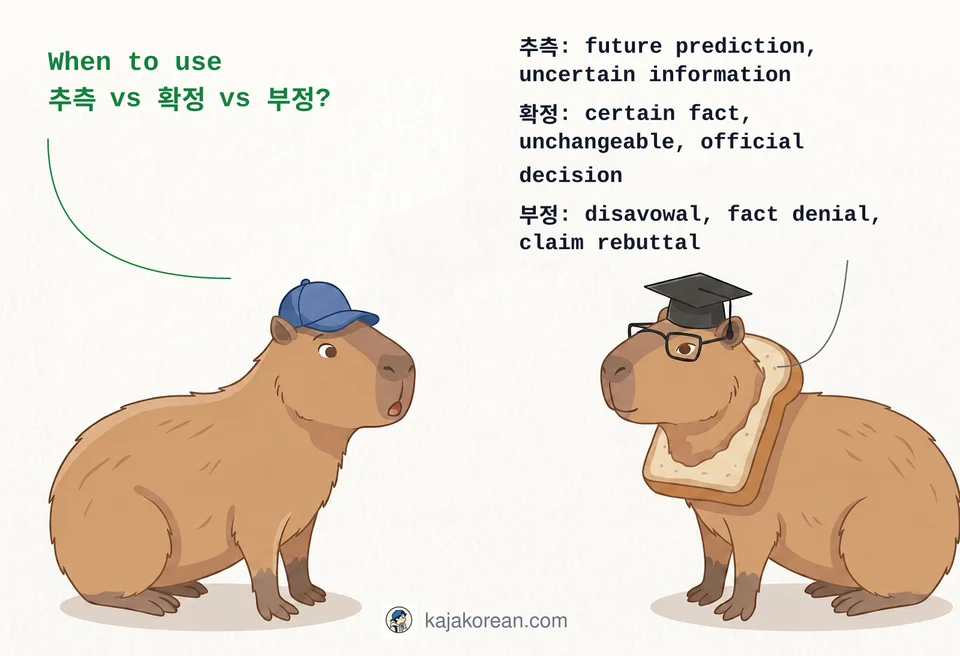
추측 vs 확정 vs 부정: The Boundary Between Uncertainty and Certainty

추측 (chu-cheuk, chucheuk) · 확정 (hwak-jeong, hwakjeong) · 부정 (bu-jeong, bujeong)

추측 expresses uncertainty or possibility, 확정 states certainty or fact, and 부정 denies a fact or claim.

Comparison of Korean words 추측, 확정, and 부정 usage

Word-by-word breakdown

One lane per word — no nested boxes, just the gist.

추측(chu-cheuk, chucheuk)

To speak about a fact with uncertainty, expressing possibility or guess

When to use

future prediction, uncertain information, expressing possibility

The nuance

Use when there is no certain evidence or fact, and you speak mainly about possibilities.

확정(hwak-jeong, hwakjeong)

To state a fact or result clearly and unchangeably with certainty

When to use

official decision, certain fact, unchangeable

The nuance

Use when the evidence is certain or the fact is officially decided.

부정(bu-jeong, bujeong)

To deny a fact or claim by saying 'not' or 'no'

When to use

fact denial, claim rebuttal, disavowal

The nuance

Use when clearly denying a claim or fact as false or untrue.

Real-world examples

  • 내일 비가 올 것 같아.

    nae-il bi-ga ol geos gat-a., nae il bi ga ol geos gat a.

    It's an uncertain prediction about the future, so 추측 is appropriate.

  • 내일 비가 올 것이 확정되었어.

    nae-il bi-ga ol geos-i hwak-jeong-doe-eoss-eo., nae il bi ga ol geos i hwak jeong doe eoss eo.

    It states an officially decided fact, so 확정 is correct.

  • 내일 비가 오지 않을 거야, 그거 부정해.

    nae-il bi-ga o-ji an-eul geo-ya, geu-geo bu-jeong-hae., nae il bi ga o ji an eul geo ya, geu geo bu jeong hae.

    It denies the claim that it will rain, so 부정 is appropriate.

  • 내일 비가 올 것 확정해.

    nae-il bi-ga ol geos hwak-jeong-hae., nae il bi ga ol geos hwak jeong hae.

    확정 is for official or certain facts; using it for future prediction sounds unnatural.

  • 그 사람이 거짓말한 것을 추측해.

    geu sa-ram-i geo-jis-mal-han geos-eul chu-cheuk-hae., geu sa ram i geo jis mal han geos eul chu cheuk hae.

    Lying is a fact to confirm or deny, so 추측 is inappropriate here.

  • 그가 범인이 아니라고 확정해.

    geu-ga beom-in-i a-ni-ra-go hwak-jeong-hae., geu ga beom in i a ni ra go hwak jeong hae.

    Confirming innocence requires strong evidence; simple denial suits 부정 better.

  • 그가 범인이라는 것을 부정한다.

    geu-ga beom-in-i-ra-neun geos-eul bu-jeong-han-da., geu ga beom in i ra neun geos eul bu jeong han da.

    It correctly denies the claim that he is the culprit.

  • 그가 범인일 것이라고 부정해.

    geu-ga beom-in-il geos-i-ra-go bu-jeong-hae., geu ga beom in il geos i ra go bu jeong hae.

    부정 is for denial; mixing it with 추측 causes ambiguity.

Quick quiz

  1. Which expression fits best for uncertain future prediction?

    미래에 대한 불확실한 예상에 가장 적합한 표현은?(mi-rae-edae-hanbul-hwak-sil-hanye-sang-ega-jangjeok-hap-hanpyo-hyeon-eun?, miraeedaehanbulhwaksilhanyesangegajangjeokhaphanpyohyeoneun?)
  2. Which word is most appropriate to state an officially decided fact?

    공식적으로 결정된 사실을 말할 때 가장 적절한 단어는?(gong-sik-jeok-eu-rogyeol-jeong-doensa-sil-eulmal-halttaega-jangjeok-jeol-handan-eo-neun?, gongsikjeokeurogyeoljeongdoensasileulmalhalttaegajangjeokjeolhandaneoneun?)
  3. Which word is used to deny a claim?

    어떤 주장을否定할 때 사용하는 단어는?(eo-tteonju-jang-eul否定halttaesa-yong-ha-neundan-eo-neun?, eotteonjujangeul否定halttaesayonghaneundaneoneun?)
  4. Fill in the blank: 'I ___ that he might be the culprit.'

    '그가 범인일 것이라고 ___.' 빈칸에 들어갈 말은?('geu-gabeom-in-ilgeos-i-ra-go___.'bin-kan-edeul-eo-galmal-eun?, 'geugabeominilgeosirago___.'binkanedeuleogalmaleun?)

More comparisons to explore

View all word comparisons →