많이 vs 너무 vs 아주: Mastering Degree Expressions

많이 (man-i, mani) · 너무 (neo-mu, neomu) · 아주 (a-ju, aju)

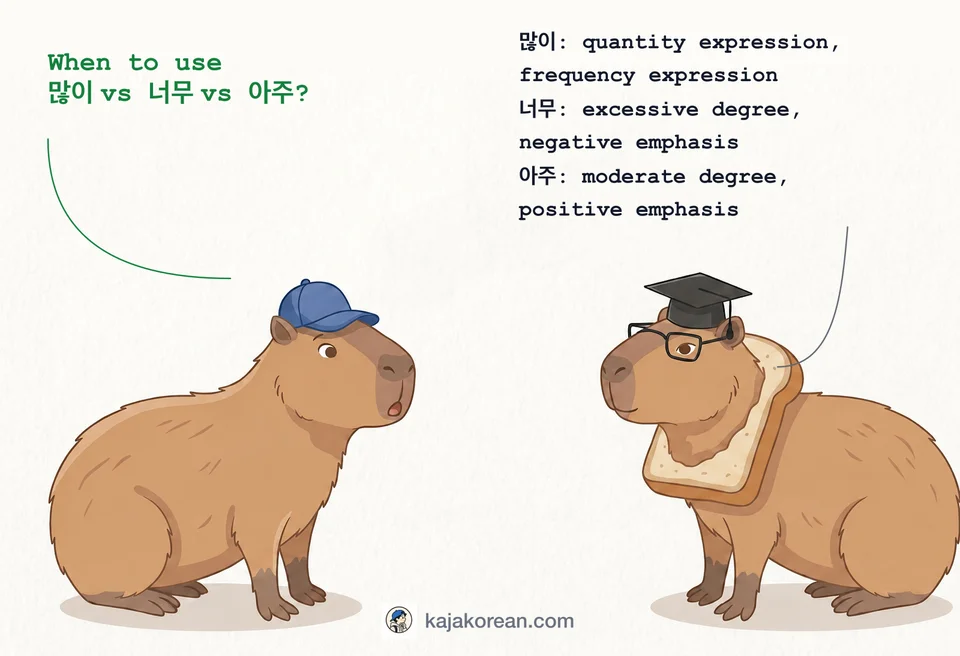
'많이 (mani)', '너무 (neomu)', and '아주 (aju)' all express degree, but 많이 indicates quantity or frequency, 너무 implies excessive or negative degree, and 아주 conveys a strong positive degree.

Comparison of Korean adverbs 많이, 너무, and 아주 expressing degree

Word-by-word breakdown

One lane per word — no nested boxes, just the gist.

많이(man-i, mani)

Indicates large quantity or frequency

When to use

quantity expression, frequency expression, both positive and negative

The nuance

많이 is used when the quantity or frequency is high; it can be used in both positive and negative contexts.

너무(neo-mu, neomu)

Used when the degree is excessive or has a negative nuance

When to use

negative emphasis, excessive degree, negative situations

The nuance

너무 is used to emphasize excessive or negative degree and is unnatural in positive contexts.

아주(a-ju, aju)

Expresses strong positive degree, suitable for moderate praise or emphasis

When to use

positive emphasis, praise expression, moderate degree

The nuance

아주 is used for strong positive emphasis in affirmative contexts and sounds natural without excess.

Real-world examples

  • 나는 어제 많이 공부했어요.

    na-neun eo-je man-i gong-bu-haess-eo-yo., na neun eo je man i gong bu haess eo yo.

    Correct use of 많이 to indicate high frequency or quantity.

  • 나는 어제 너무 공부했어요.

    na-neun eo-je neo-mu gong-bu-haess-eo-yo., na neun eo je neo mu gong bu haess eo yo.

    너무 properly expresses excessive degree here.

  • 나는 어제 아주 공부했어요.

    na-neun eo-je a-ju gong-bu-haess-eo-yo., na neun eo je a ju gong bu haess eo yo.

    아주 is unnatural alone with '공부하다' without additional context or adjective.

  • 이 음식이 너무 맛있어요!

    i eum-sik-i neo-mu mas-iss-eo-yo!, i eum sik i neo mu mas iss eo yo!

    너무 sounds excessive in positive praise; use 아주 or 정말 instead.

  • 이 음식이 아주 맛있어요!

    i eum-sik-i a-ju mas-iss-eo-yo!, i eum sik i a ju mas iss eo yo!

    아주 fits positive emphasis naturally here.

  • 그는 많이 피곤해 보여요.

    geu-neun man-i pi-gon-hae bo-yeo-yo., geu neun man i pi gon hae bo yeo yo.

    많이 correctly expresses large degree of tiredness.

  • 그는 너무 피곤해 보여요.

    geu-neun neo-mu pi-gon-hae bo-yeo-yo., geu neun neo mu pi gon hae bo yeo yo.

    너무 properly emphasizes excessive tiredness.

  • 그는 아주 피곤해 보여요.

    geu-neun a-ju pi-gon-hae bo-yeo-yo., geu neun a ju pi gon hae bo yeo yo.

    아주 is unnatural with negative states like tiredness.

Quick quiz

  1. Which is the most natural expression for positive praise?

    다음 중 긍정적인 칭찬에 가장 자연스러운 표현은?(da-eumjunggeung-jeong-jeok-inching-chan-ega-jangja-yeon-seu-reo-unpyo-hyeon-eun?, daeumjunggeungjeongjeokinchingchanegajangjayeonseureounpyohyeoneun?)
  2. Which word expresses an excessive degree?

    '과도한' 느낌을 줄 때 사용하는 단어는?('gwa-do-han'neu-kkim-euljulttaesa-yong-ha-neundan-eo-neun?, 'gwadohan'neukkimeuljulttaesayonghaneundaneoneun?)
  3. Which word is appropriate to express large quantity or frequency?

    양이나 빈도가 많음을 표현할 때 적절한 단어는?(yang-i-nabin-do-gaman-eum-eulpyo-hyeon-halttaejeok-jeol-handan-eo-neun?, yanginabindogamaneumeulpyohyeonhalttaejeokjeolhandaneoneun?)

More comparisons to explore

View all word comparisons →