
여기(yeo-gi, yeogi)
Used to indicate a place very close to the speaker
When to use
Near speaker, Speaker's location, Within speaker's reach
The nuance
Use 여기 when referring to a place near the speaker, regardless of the listener's location.
여기 (yeo-gi, yeogi) · 저기 (jeo-gi, jeogi) · 거기 (geo-gi, geogi)
여기 (yeogi), 저기 (jeogi), and 거기 (geogi) all indicate locations but differ based on the speaker's and listener's relative distance and context.
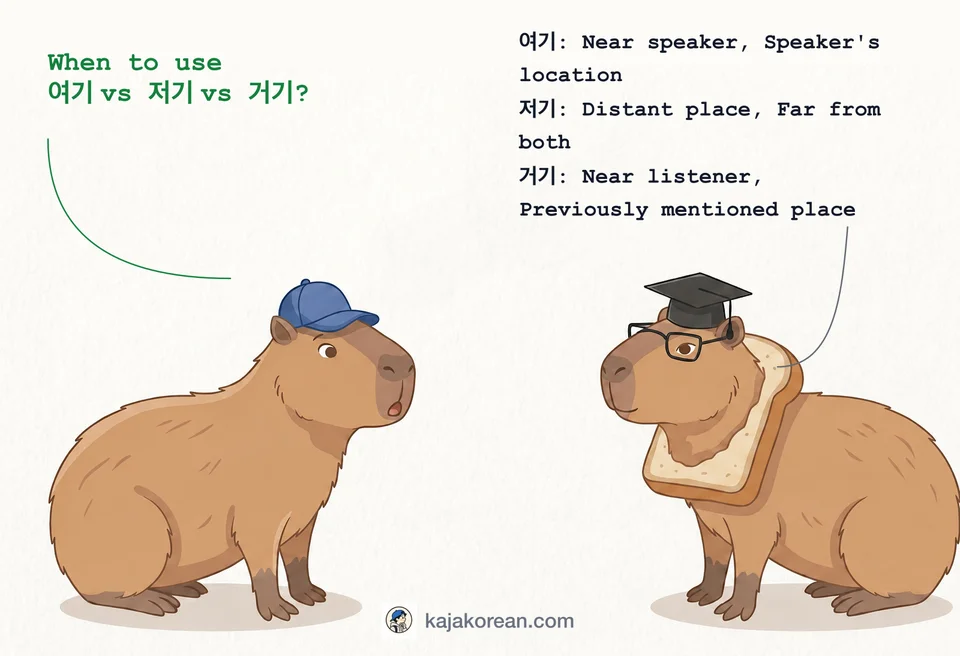
One lane per word — no nested boxes, just the gist.
Used to indicate a place very close to the speaker
When to use
Near speaker, Speaker's location, Within speaker's reach
The nuance
Use 여기 when referring to a place near the speaker, regardless of the listener's location.
Used to indicate a place far from both speaker and listener
When to use
Distant place, Far from both, Visible but far away
The nuance
Use 저기 to refer to a place distant from both speaker and listener, often for faraway objects or locations.
Used to indicate a place near the listener, between speaker and listener, or a previously mentioned place
When to use
Near listener, Between speaker and listener, Previously mentioned place
The nuance
Use 거기 to indicate a place near the listener, between speaker and listener, or a previously mentioned location.
여기 앉으세요.
yeo-gi an-eu-se-yo., yeo gi an eu se yo.
Here is near the speaker, so 여기 is appropriate.
저기 앉으세요.
jeo-gi an-eu-se-yo., jeo gi an eu se yo.
저기 indicates a place far from both speaker and listener, so it's correct.
거기 앉으세요.
geo-gi an-eu-se-yo., geo gi an eu se yo.
거기 is used for places near the listener, so it's correct.
여기 멀리 있어요.
yeo-gi meol-ri iss-eo-yo., yeo gi meol ri iss eo yo.
여기 means near speaker, so pairing with 'far' is illogical; use 저기 instead.
저기 내 자리야.
jeo-gi nae ja-ri-ya., jeo gi nae ja ri ya.
My seat is near speaker, so 여기 or 거기 fits better; 저기 implies far away.
거기 내 책상이에요.
geo-gi nae chaek-sang-i-e-yo., geo gi nae chaek sang i e yo.
거기 is correct for places near the listener.
저기 내 가방이야.
jeo-gi nae ga-bang-i-ya., jeo gi nae ga bang i ya.
저기 is used for objects far from both speaker and listener.
거기 너무 가까워요.
geo-gi neo-mu ga-kka-wo-yo., geo gi neo mu ga kka wo yo.
'Too close' fits better with 여기 (near speaker), so 거기 is incorrect here.
Which word do you use to indicate a place right in front of the speaker?
Which word is appropriate for a place far from both speaker and listener?
Which word do you use to indicate a place near the listener?
What does it mean?