능동 vs 수동 vs 피동: Differences in Expressing Subject and Action

능동 (neung-dong, neungdong) · 수동 (su-dong, sudong) · 피동 (pi-dong, pidong)

능동 (neungdong), 수동 (sudong), and 피동 (pidong) distinguish whether the subject performs, receives, or is indirectly affected by an action.

Comparison of Korean 능동, 수동, and 피동 verb forms

Word-by-word breakdown

One lane per word — no nested boxes, just the gist.

능동(neung-dong, neungdong)

Subject actively performing the action

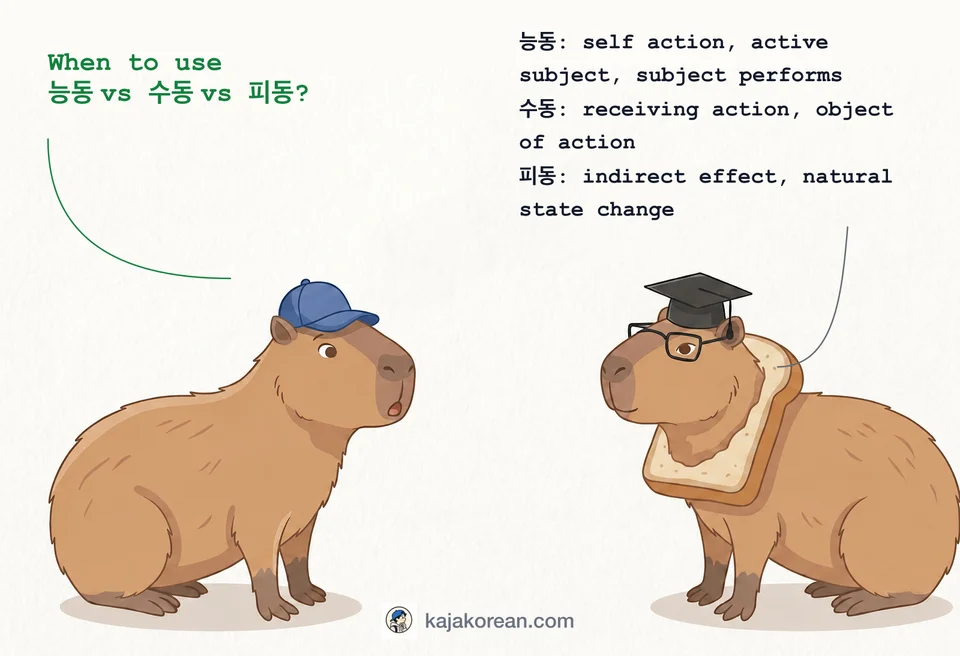
When to use

active subject, self action, subject performs

The nuance

능동 is used when the subject actively performs the action. The subject is the doer who initiates or carries out the behavior or change.

수동(su-dong, sudong)

Subject receiving or undergoing an action by someone else

When to use

receiving action, affected by others, object of action

The nuance

수동 is used when the subject passively receives the action performed by another agent or external cause. It shows the subject as the recipient or target of the action.

피동(pi-dong, pidong)

Subject indirectly or naturally affected by an action or change

When to use

indirect effect, natural state change, broad passive meaning

The nuance

피동 is used when the subject is not the direct doer but is indirectly affected or naturally changes state due to someone else's action. It covers a broader sense of being affected than 수동.

Real-world examples

  • 나는 책을 읽는다.

    na-neun chaek-eul ik-neun-da., na neun chaek eul ik neun da.

    Subject 'I' actively performs the action, so it's 능동.

  • 책이 나에게 읽힌다.

    chaek-i na-e-ge ik-hin-da., chaek i na e ge ik hin da.

    The book is the passive recipient of the action, so 수동 is correct.

  • 나는 친구에게 책이 읽힌다.

    na-neun chin-gu-e-ge chaek-i ik-hin-da., na neun chin gu e ge chaek i ik hin da.

    Subject 'I' is not the doer; '읽힌다' is 피동 but mismatched here.

  • 문이 열렸다.

    mun-i yeol-ryeoss-da., mun i yeol ryeoss da.

    The door undergoes a natural state change, so 피동 is appropriate.

  • 나는 문을 열렸다.

    na-neun mun-eul yeol-ryeoss-da., na neun mun eul yeol ryeoss da.

    Subject acts directly, so 능동 form is needed, not 피동.

  • 그가 나를 도와준다.

    geu-ga na-reul do-wa-jun-da., geu ga na reul do wa jun da.

    Subject actively helps, so 능동 is correct.

  • 나는 그에게 도와진다.

    na-neun geu-e-ge do-wa-jin-da., na neun geu e ge do wa jin da.

    Subject receives help, so 수동 is correct.

  • 나는 그에게 도와진다.

    na-neun geu-e-ge do-wa-jin-da., na neun geu e ge do wa jin da.

    Subject indirectly affected, so 피동 can also apply here.

Quick quiz

  1. Which is an 능동 sentence?

    능동 문장에 해당하는 것은?(neung-dongmun-jang-ehae-dang-ha-neungeos-eun?, neungdongmunjangehaedanghaneungeoseun?)
  2. Which sentence correctly uses 수동?

    수동 표현이 맞는 문장은?(su-dongpyo-hyeon-imaj-neunmun-jang-eun?, sudongpyohyeonimajneunmunjangeun?)
  3. When is 피동 appropriate?

    피동 표현이 적절한 상황은?(pi-dongpyo-hyeon-ijeok-jeol-hansang-hwang-eun?, pidongpyohyeonijeokjeolhansanghwangeun?)

More comparisons to explore

View all word comparisons →