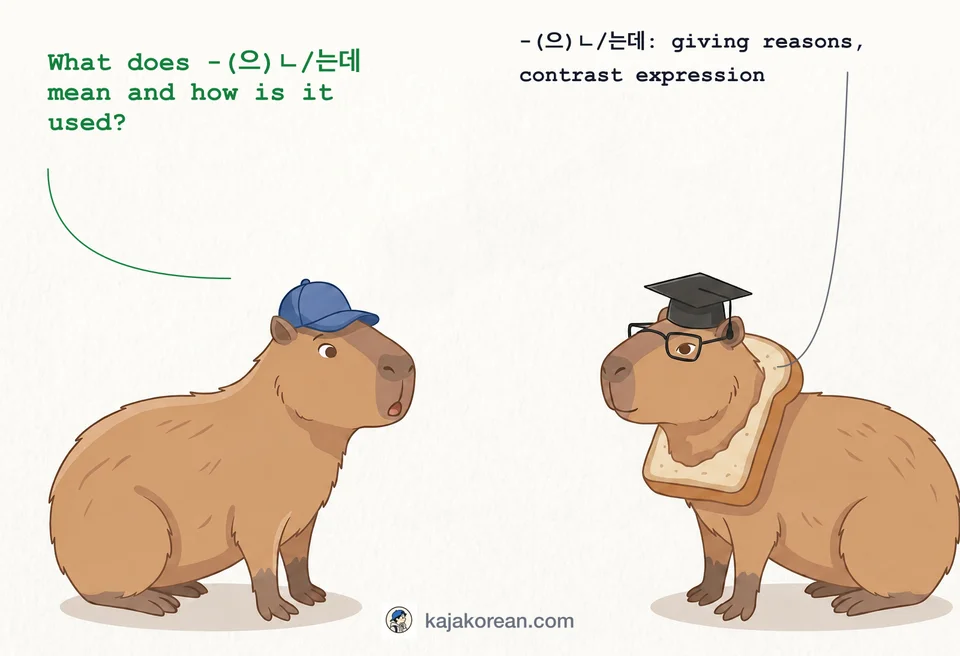
How to use 은/는데 in Korean

Pattern: -(으)ㄴ/는데

-(으)ㄴ/는데 (-(eu)ㄴ, (eu)ㄴ, neun-de, neunde)

-(으)ㄴ/는데 is a versatile connective ending used for background info, contrast, and reasons.

Korean grammar -(으)ㄴ/는데 usage guide

Usage guide

When and how native speakers actually use it.

-(으)ㄴ/는데(-(eu)ㄴ, (eu)ㄴ, neun-de, neunde)

A connective ending used to give background, contrast, or reasons

When to use

background explanation, contrast expression, giving reasons, questions and answers

The nuance

Attach -(으)ㄴ데 to past tense verbs/adjectives, -는데 to present tense verbs/adjectives, and (이)ㄴ데 to nouns. The first clause provides background or context; the second clause often shows contrast, result, suggestion, or question.

Real-world examples

  • 비가 오는데 우산을 가져가세요.

    bi-ga o-neun-de u-san-eul ga-jyeo-ga-se-yo., bi ga o neun de u san eul ga jyeo ga se yo.

    Present verb stem '오다' + -는데 is correctly used.

  • 어제 본 영화가 재미있는데 같이 볼래요?

    eo-je bon yeong-hwa-ga jae-mi-iss-neun-de gat-i bol-rae-yo?, eo je bon yeong hwa ga jae mi iss neun de gat i bol rae yo?

    Past verb '보다' + -(으)ㄴ데 correctly connects to a suggestion.

  • 친구인데 학교에 안 왔어요.

    chin-gu-in-de hak-gyo-e an wass-eo-yo., chin gu in de hak gyo e an wass eo yo.

    Noun '친구' + (이)ㄴ데 correctly expresses contrast.

  • 밥을 먹는데 TV를 봐요.

    bap-eul meok-neun-de tvreul bwa-yo., bap eul meok neun de tvreul bwa yo.

    Present verb + -는데 correctly shows simultaneous actions.

  • 비가 오는데 우산을 안 가져왔어요.

    bi-ga o-neun-de u-san-eul an ga-jyeo-wass-eo-yo., bi ga o neun de u san eul an ga jyeo wass eo yo.

    Clearly shows background situation and contrast.

  • 어제 갔는데 사람이 많았어요.

    eo-je gass-neun-de sa-ram-i man-ass-eo-yo., eo je gass neun de sa ram i man ass eo yo.

    Past verb + -(으)ㄴ데 naturally describes situation.

  • 학생인데 선생님이에요.

    hak-saeng-in-de seon-saeng-nim-i-e-yo., hak saeng in de seon saeng nim i e yo.

    Noun + (이)ㄴ데 used for contrast/background, but sentence is contradictory and unnatural.

  • 먹었는데 밥을 안 먹었어요.

    meok-eoss-neun-de bap-eul an meok-eoss-eo-yo., meok eoss neun de bap eul an meok eoss eo yo.

    Past verb + -(으)ㄴ데 clearly shows contrast.

Quick quiz

  1. Which sentence correctly uses -(으)ㄴ/는데?

    다음 중 -(으)ㄴ/는데를 올바르게 사용한 문장은?(da-eumjung-(eu)ㄴ, daeumjung(eu)ㄴ, neun-de-reulol-ba-reu-gesa-yong-hanmun-jang-eun?, neundereulolbareugesayonghanmunjangeun?)
  2. Which is NOT a use of -(으)ㄴ/는데?

    -(으)ㄴ/는데의 용도가 아닌 것은?(-(eu)ㄴ, (eu)ㄴ, neun-de-uiyong-do-gaa-ningeos-eun?, neundeuiyongdogaaningeoseun?)
  3. Which is a correct example of noun + -(이)ㄴ데?

    명사 + -(이)ㄴ데의 올바른 예는?(myeong-sa+-(i)ㄴde-uiol-ba-reunye-neun?, myeongsa+(i)ㄴdeuiolbareunyeneun?)

More usage guides

View all usage guides →