How to use 으면/면 in Korean

Pattern: -(으)면

-(으)면 (-(eu)myeon, (eu)myeon)

-(으)면 is a conditional ending used to express 'if' or 'when' in Korean. Essential for talking about conditions or hypothetical situations.

Korean conditional grammar -(으)면 explained

Usage guide

When and how native speakers actually use it.

-(으)면(-(eu)myeon, (eu)myeon)

Indicates 'if' or 'when' a certain condition is met.

When to use

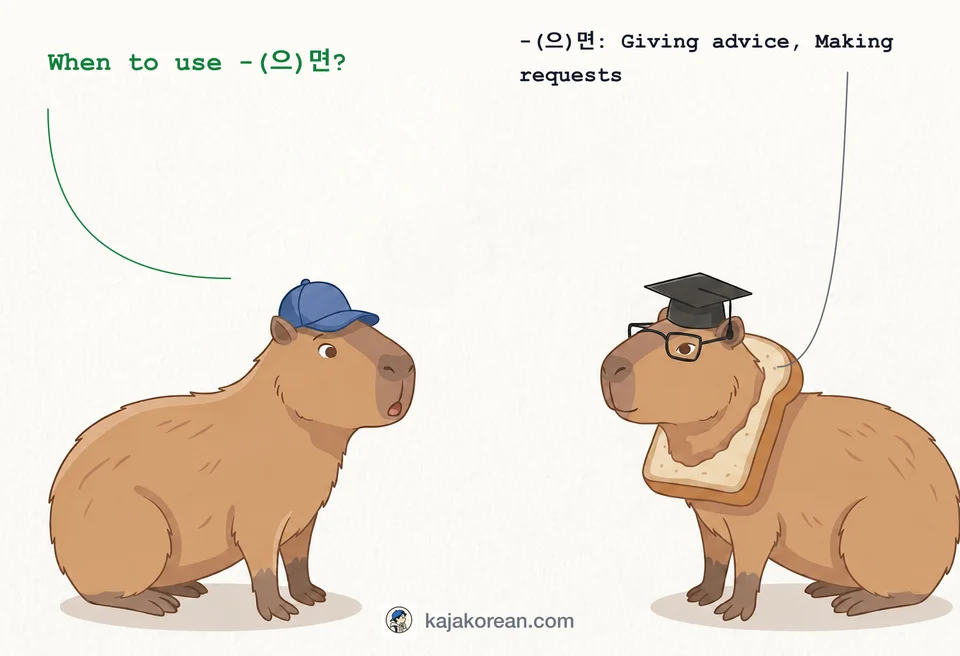
Stating conditions, Expressing hypotheticals, Giving advice, Making requests

The nuance

Attach to the verb or adjective stem: use '-으면' if the stem ends with a consonant, '-면' if it ends with a vowel. For past tense conditions, use '-았으면/었으면'. It expresses condition or hypothetical situations.

Real-world examples

  • 비가 오면 집에 있을 거예요.

    bi-ga o-myeon jip-e iss-eul geo-ye-yo., bi ga o myeon jip e iss eul geo ye yo.

    The verb '오다' has no final consonant, so '-면' is used. It clearly expresses condition.

  • 시간이 있으면 같이 영화 볼래요?

    si-gan-i iss-eu-myeon gat-i yeong-hwa bol-rae-yo?, si gan i iss eu myeon gat i yeong hwa bol rae yo?

    '있다' ends with a consonant, so '-으면' is naturally attached.

  • 먹으면 건강해요.

    meok-eu-myeon geon-gang-hae-yo., meok eu myeon geon gang hae yo.

    '먹다' ends with a consonant, so '-으면' indicates condition.

  • 공부하면 시험에 합격할 거예요.

    gong-bu-ha-myeon si-heom-e hap-gyeok-hal geo-ye-yo., gong bu ha myeon si heom e hap gyeok hal geo ye yo.

    '공부하다' ends with a vowel, so '-면' indicates condition.

  • 비가 오면, 우리는 나갈 거예요.

    bi-ga o-myeon, u-ri-neun na-gal geo-ye-yo., bi ga o myeon, u ri neun na gal geo ye yo.

    The sentence is logically contradictory; if it rains, usually people don't go out.

  • 운동하면 건강할 거예요.

    un-dong-ha-myeon geon-gang-hal geo-ye-yo., un dong ha myeon geon gang hal geo ye yo.

    '운동하다' ends with a vowel, so '-면' expresses condition.

  • 늦으면 전화해 주세요.

    neuj-eu-myeon jeon-hwa-hae ju-se-yo., neuj eu myeon jeon hwa hae ju se yo.

    '늦다' ends with a consonant, so '-으면' is used to indicate condition for request.

Quick quiz

  1. Which of the following is a correct use of '-(으)면'?

    다음 중 '-(으)면'의 올바른 사용 예는?(da-eumjung'-(eu)myeon'uiol-ba-reunsa-yongye-neun?, daeumjung'(eu)myeon'uiolbareunsayongyeneun?)
  2. What does '-(으)면' mean?

    '-(으)면'은 어떤 의미인가요?('-(eu)myeon'euneo-tteonui-mi-in-ga-yo?, '(eu)myeon'euneotteonuimiingayo?)
  3. How do you attach '-(으)면' to the verb '먹다'?

    '먹다' 동사에 '-(으)면'을 붙이면?('meok-da'dong-sa-e'-(eu)myeon'eulbut-i-myeon?, 'meokda'dongsae'(eu)myeon'eulbutimyeon?)

More usage guides

View all usage guides →