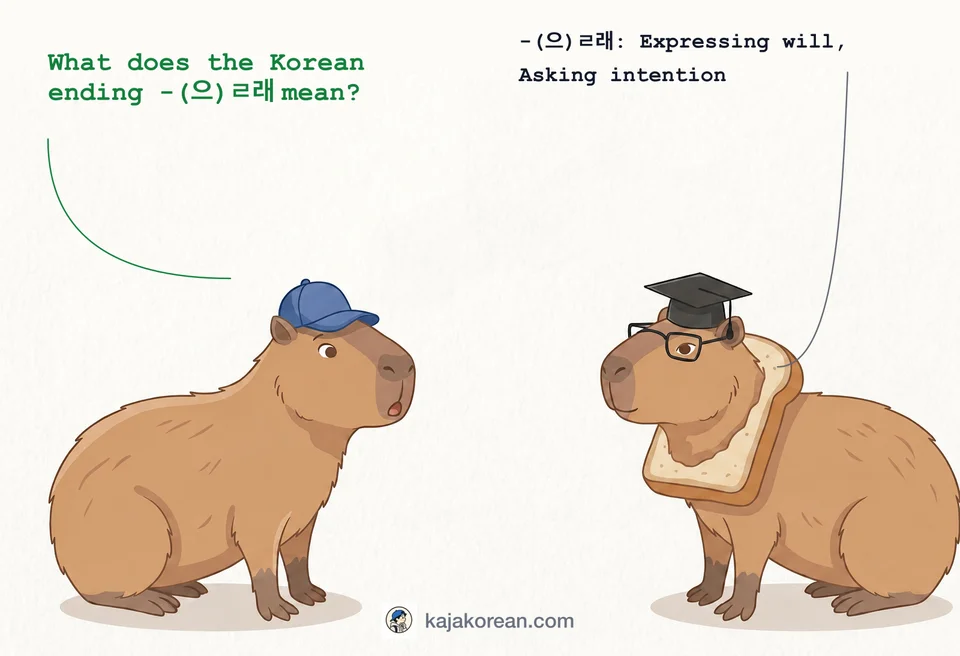
How to use 을/ㄹ래 in Korean

Pattern: -(으)ㄹ래

-(으)ㄹ래 (-(eu)ㄹrae, (eu)ㄹrae)

-(으)ㄹ래 is a sentence ending used to ask someone's intention or express your own will.

Korean grammar ending -(으)ㄹ래 usage

Usage guide

When and how native speakers actually use it.

-(으)ㄹ래(-(eu)ㄹrae, (eu)ㄹrae)

Expression to ask someone's intention or express one's own will

When to use

Making suggestions, Asking intention, Expressing will

The nuance

Attach to the verb stem: use '-을래' if the stem ends with a consonant, '-ㄹ래' if it ends with a vowel. Used mainly to ask someone's intention or make a suggestion. Examples: 먹다 → 먹을래? 가다 → 갈래?

Real-world examples

  • 영화 볼래?

    yeong-hwa bol-rae?, yeong hwa bol rae?

    The verb '보다' has no final consonant, so '-ㄹ래' is used to ask intention.

  • 밥 먹을래?

    bap meok-eul-rae?, bap meok eul rae?

    The verb '먹다' ends with a consonant, so '-을래' is used to ask intention.

  • 내일 일찍 일어날래.

    nae-il il-jjik il-eo-nal-rae., nae il il jjik il eo nal rae.

    Used to express one's own will.

  • 공부할래?

    gong-bu-hal-rae?, gong bu hal rae?

    The stem '공부하' ends with a vowel, so '-ㄹ래' is used.

  • 커피 마실래?

    keo-pi ma-sil-rae?, keo pi ma sil rae?

    The verb '마시다' ends with a vowel, so '-ㄹ래' is used to suggest.

  • 책 읽을래?

    chaek ik-eul-rae?, chaek ik eul rae?

    The verb '읽다' ends with a consonant, so '-을래' is used.

  • 내가 갈래.

    nae-ga gal-rae., nae ga gal rae.

    Expressing one's own will with '-ㄹ래'.

  • 밥 먹ㄹ래?

    bap meokㄹrae?

    For verbs with a final consonant, '-을래' must be used, so '먹ㄹ래' is incorrect.

Quick quiz

  1. Which sentence correctly uses '-(으)ㄹ래'?

    다음 중 '-(으)ㄹ래'를 올바르게 사용한 문장은?(da-eumjung'-(eu)ㄹrae'reulol-ba-reu-gesa-yong-hanmun-jang-eun?, daeumjung'(eu)ㄹrae'reulolbareugesayonghanmunjangeun?)
  2. Which verb should take '-을래'?

    '-을래'를 붙여야 하는 동사는?('-eul-rae'reulbut-yeo-yaha-neundong-sa-neun?, 'eulrae'reulbutyeoyahaneundongsaneun?)
  3. What does '내일 같이 갈래?' mean?

    다음 문장의 의미는? '내일 같이 갈래?'(da-eummun-jang-uiui-mi-neun?'nae-ilgat-igal-rae?', daeummunjanguiuimineun?'naeilgatigalrae?')

More usage guides

View all usage guides →