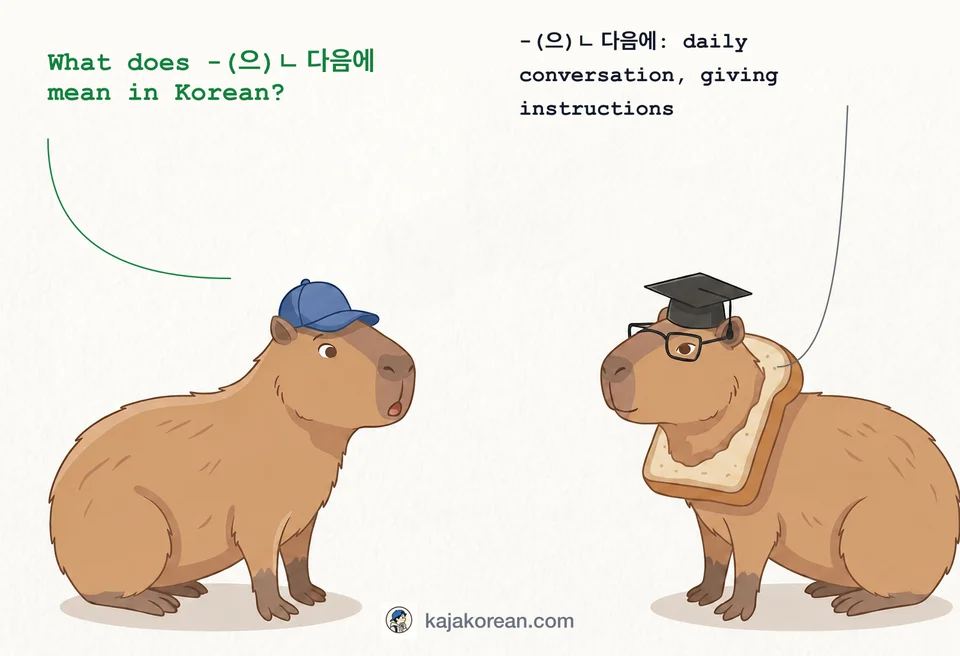
How to use 은/ㄴ 다음에 in Korean

Pattern: -(으)ㄴ 다음에

-(으)ㄴ 다음에 (-(eu)ㄴda-eum-e, (eu)ㄴdaeume)

-(으)ㄴ 다음에 shows that one action happens after another finishes. It's common in daily life and business.

Korean grammar pattern -(으)ㄴ 다음에 usage guide

Usage guide

When and how native speakers actually use it.

-(으)ㄴ 다음에(-(eu)ㄴda-eum-e, (eu)ㄴdaeume)

A connective ending indicating that one action happens after another finishes

When to use

giving instructions, daily conversation, business directions

The nuance

Attach '-은 다음에' after verb stems ending with a consonant, and '-ㄴ 다음에' after stems ending with a vowel. It indicates that the main clause action happens after the subordinate clause action is completed, often implying past or completed actions.

Real-world examples

  • 저녁을 먹은 다음에 운동할 거예요.

    jeo-nyeok-eul meok-eun da-eum-e un-dong-hal geo-ye-yo., jeo nyeok eul meok eun da eum e un dong hal geo ye yo.

    '먹다' ends with a vowel 'ㅓ', so '-ㄴ 다음에' is correctly attached as '먹은 다음에'.

  • 숙제를 한 다음에 친구를 만났어요.

    suk-je-reul han da-eum-e chin-gu-reul man-nass-eo-yo., suk je reul han da eum e chin gu reul man nass eo yo.

    '하다' has no final consonant but in past form uses '-ㄴ 다음에' as '한 다음에'.

  • 영화를 보고난 다음에 집에 갔어요.

    yeong-hwa-reul bo-go-nan da-eum-e jip-e gass-eo-yo., yeong hwa reul bo go nan da eum e jip e gass eo yo.

    '보고난' is incorrect; it should be spaced as '보고 난 다음에' or better '본 다음에'.

  • 회의를 마친 다음에 보고서를 작성하세요.

    hoe-ui-reul ma-chin da-eum-e bo-go-seo-reul jak-seong-ha-se-yo., hoe ui reul ma chin da eum e bo go seo reul jak seong ha se yo.

    '마치다' ends with consonant, so '-은 다음에' correctly forms '마친 다음에'.

  • 공부한 다음에 쉬자.

    gong-bu-han da-eum-e swi-ja., gong bu han da eum e swi ja.

    '공부하다' in past form uses '-ㄴ 다음에' as '공부한 다음에'.

  • 저는 출근한 다음에 커피를 마셔요.

    jeo-neun chul-geun-han da-eum-e keo-pi-reul ma-syeo-yo., jeo neun chul geun han da eum e keo pi reul ma syeo yo.

    '출근하다' uses '-ㄴ 다음에' correctly as '출근한 다음에'.

Quick quiz

  1. Which sentence is correct?

    다음 중 올바른 문장은?(da-eumjungol-ba-reunmun-jang-eun?, daeumjungolbareunmunjangeun?)
  2. What does '-(으)ㄴ 다음에' mean?

    '-(으)ㄴ 다음에'의 의미는?('-(eu)ㄴda-eum-e'uiui-mi-neun?, '(eu)ㄴdaeume'uiuimineun?)
  3. What is the correct form with '먹다'?

    '먹다'에 올바른 형태는?('meok-da'eol-ba-reunhyeong-tae-neun?, 'meokda'eolbareunhyeongtaeneun?)

More usage guides

View all usage guides →