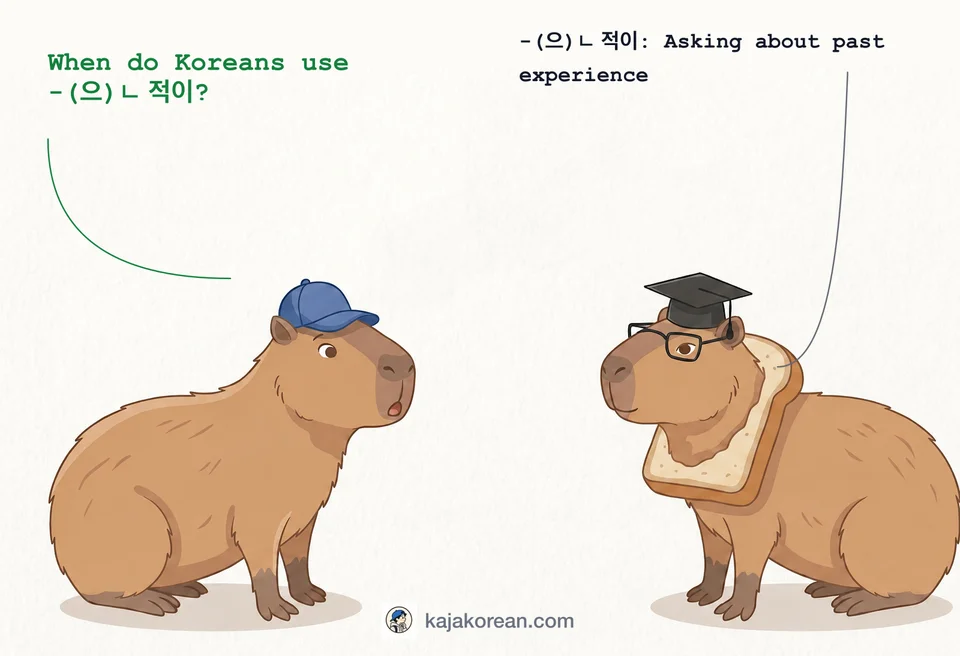
How to use 은/ㄴ 적이 in Korean

Pattern: -(으)ㄴ 적이

-(으)ㄴ 적이 (-(eu)ㄴjeok-i, (eu)ㄴjeoki)

-(으)ㄴ 적이 is used to talk about past experiences. It's handy when naturally asking or stating if someone has done something before.

Korean grammar -(으)ㄴ 적이 usage

Usage guide

When and how native speakers actually use it.

-(으)ㄴ 적이(-(eu)ㄴjeok-i, (eu)ㄴjeoki)

An expression indicating past experience of having done something

When to use

Asking about past experience, Talking about one's experience, Checking someone else's experience

The nuance

Attach '-(으)ㄴ 적이 있다/없다' to the verb stem to express past experience. Use '-은 적이' if the stem ends with a consonant, '-ㄴ 적이' if it ends with a vowel. Example: 가다 → 간 적이 있다, 먹다 → 먹은 적이 있다.

Real-world examples

  • 한국에 가 본 적이 있어요.

    han-guk-e ga bon jeok-i iss-eo-yo., han guk e ga bon jeok i iss eo yo.

    '가다' ends with a vowel, so '-ㄴ 적이' is correct as in '가 본 적이'.

  • 저는 그 영화를 본 적이 없어요.

    jeo-neun geu yeong-hwa-reul bon jeok-i eop-eo-yo., jeo neun geu yeong hwa reul bon jeok i eop eo yo.

    '보다' ends with a vowel, so '-ㄴ 적이' is correct.

  • 먹은 적이 있어요.

    meok-eun jeok-i iss-eo-yo., meok eun jeok i iss eo yo.

    '먹다' ends with a consonant, so '-은 적이' is correct.

  • 운동한 적이 많아요.

    un-dong-han jeok-i man-a-yo., un dong han jeok i man a yo.

    '운동하다' ends with a vowel, so '-ㄴ 적이' is correct.

  • 간 적이 없어요.

    gan jeok-i eop-eo-yo., gan jeok i eop eo yo.

    '가다' ends with a vowel, so '-ㄴ 적이' is correct.

  • 읽은 적이 있어요.

    ik-eun jeok-i iss-eo-yo., ik eun jeok i iss eo yo.

    '읽다' ends with a consonant, so '-은 적이' is correct.

  • 본 적이 있어요.

    bon jeok-i iss-eo-yo., bon jeok i iss eo yo.

    The past form of '보다' is '봤다', stem '보' plus '-ㄴ 적이' makes '본 적이'.

  • 읽은 적이 없어요.

    ik-eun jeok-i eop-eo-yo., ik eun jeok i eop eo yo.

    '읽다' ends with a consonant, so '-은 적이' is correct.

Quick quiz

  1. Which sentence correctly uses '-(으)ㄴ 적이'?

    다음 중 '-(으)ㄴ 적이'를 올바르게 사용한 문장은?(da-eumjung'-(eu)ㄴjeok-i'reulol-ba-reu-gesa-yong-hanmun-jang-eun?, daeumjung'(eu)ㄴjeoki'reulolbareugesayonghanmunjangeun?)
  2. Which '-(으)ㄴ 적이' form fits the verb '먹다'?

    '먹다' 동사에 맞는 '-(으)ㄴ 적이' 표현은?('meok-da'dong-sa-emaj-neun'-(eu)ㄴjeok-i'pyo-hyeon-eun?, 'meokda'dongsaemajneun'(eu)ㄴjeoki'pyohyeoneun?)
  3. Which sentence is incorrect?

    다음 문장 중 틀린 문장은?(da-eummun-jangjungteul-rinmun-jang-eun?, daeummunjangjungteulrinmunjangeun?)

More usage guides

View all usage guides →