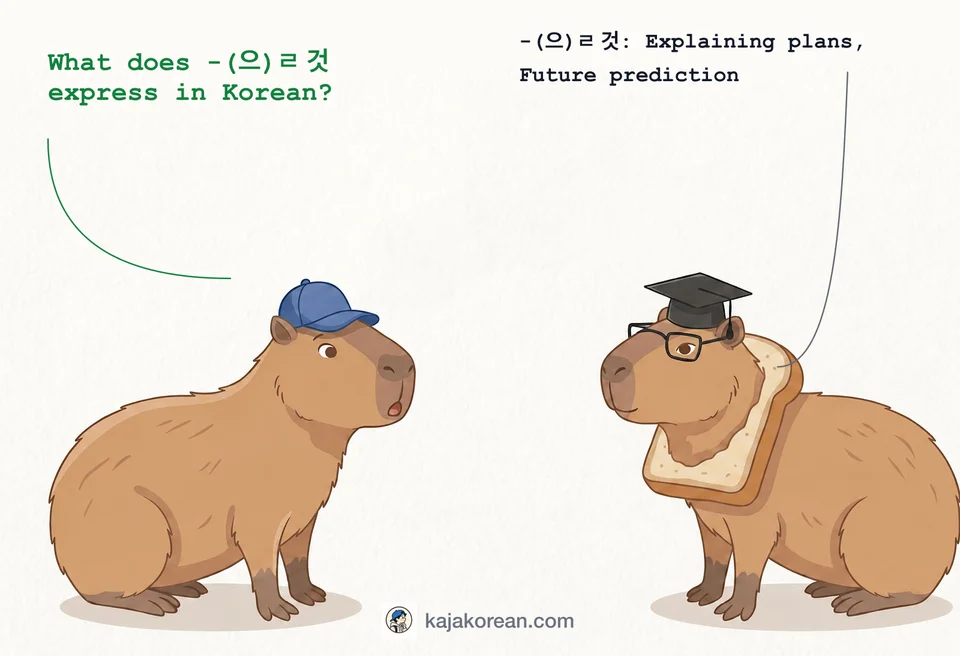
How to use 을/ㄹ 것 in Korean

Pattern: -(으)ㄹ 것

-(으)ㄹ 것 (-(eu)ㄹgeos, (eu)ㄹgeos)

-(으)ㄹ 것 is a Korean grammar pattern used to express future actions or guesses. It's simple but versatile in many contexts.

Korean grammar pattern -(으)ㄹ 것 explained

Usage guide

When and how native speakers actually use it.

-(으)ㄹ 것(-(eu)ㄹgeos, (eu)ㄹgeos)

Indicates future actions or assumptions.

When to use

Future prediction, Expressing assumptions, Explaining plans

The nuance

Attach '-(으)ㄹ 것' to the verb stem to indicate future or assumption. Use '-을 것' if the stem ends with a consonant, '-ㄹ 것' if it ends with a vowel. For example: 가다 → 갈 것, 먹다 → 먹을 것. Commonly used with '이다' as '~일 것이다' to emphasize certainty or guess.

Real-world examples

  • 내일 비가 올 것이다.

    nae-il bi-ga ol geos-i-da., nae il bi ga ol geos i da.

    Correctly expresses future prediction using '-(으)ㄹ 것'.

  • 그 사람은 지금 집에 있을 것 같아요.

    geu sa-ram-eun ji-geum jip-e iss-eul geos gat-a-yo., geu sa ram eun ji geum jip e iss eul geos gat a yo.

    Natural use of '-(으)ㄹ 것 같다' for assumption.

  • 나는 먹을 것 책을 샀다.

    na-neun meok-eul geos chaek-eul sass-da., na neun meok eul geos chaek eul sass da.

    '먹을 것' does not fit here grammatically; wrong usage.

  • 그는 내일 회의에 참석할 것이다.

    geu-neun nae-il hoe-ui-e cham-seok-hal geos-i-da., geu neun nae il hoe ui e cham seok hal geos i da.

    Correct sentence expressing future plan.

  • 나는 공부할 것을 좋아한다.

    na-neun gong-bu-hal geos-eul joh-a-han-da., na neun gong bu hal geos eul joh a han da.

    '공부할 것' does not fit with 'like'; incorrect usage.

  • 이 문제는 어려울 것이다.

    i mun-je-neun eo-ryeo-ul geos-i-da., i mun je neun eo ryeo ul geos i da.

    Properly expresses assumption about the future.

  • 그녀는 지금 집에 갈 것이다.

    geu-nyeo-neun ji-geum jip-e gal geos-i-da., geu nyeo neun ji geum jip e gal geos i da.

    Appropriate expression of future certainty.

Quick quiz

  1. Which of the following correctly uses '-(으)ㄹ 것'?

    다음 중 '-(으)ㄹ 것'의 올바른 사용 예는?(da-eumjung'-(eu)ㄹgeos'uiol-ba-reunsa-yongye-neun?, daeumjung'(eu)ㄹgeos'uiolbareunsayongyeneun?)
  2. What does '-(으)ㄹ 것' mainly express?

    '-(으)ㄹ 것'은 주로 무엇을 나타낼 때 쓰이나요?('-(eu)ㄹgeos'eunju-romu-eos-eulna-ta-naelttaesseu-i-na-yo?, '(eu)ㄹgeos'eunjuromueoseulnatanaelttaesseuinayo?)
  3. What is the '-(으)ㄹ 것' form of '가다'?

    '가다' 동사에 '-(으)ㄹ 것'을 붙이면?('ga-da'dong-sa-e'-(eu)ㄹgeos'eulbut-i-myeon?, 'gada'dongsae'(eu)ㄹgeos'eulbutimyeon?)

More usage guides

View all usage guides →