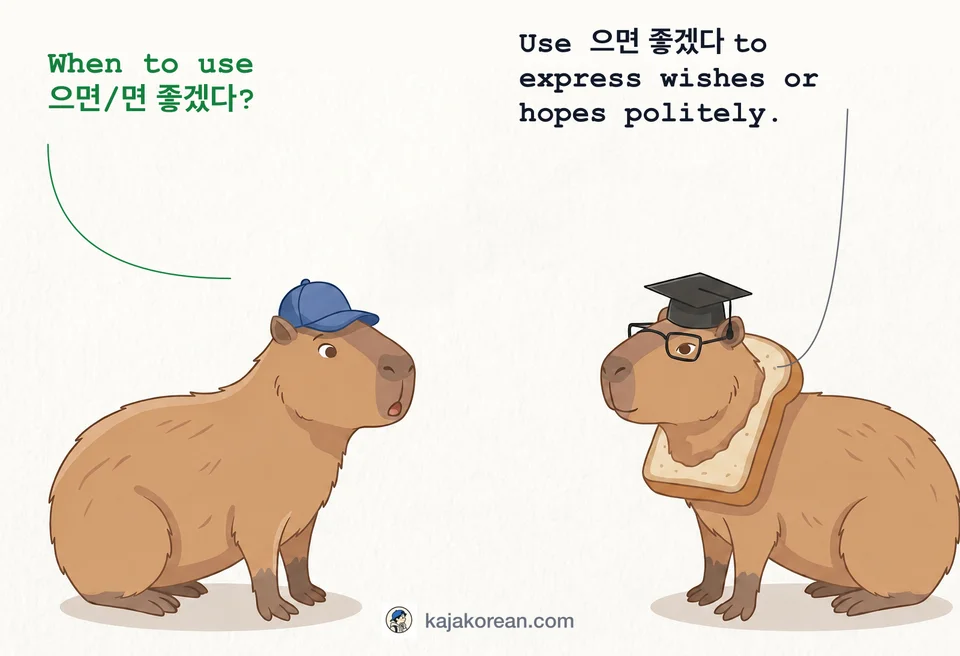
How to use 으면/면 좋겠다 in Korean

Pattern: -(으)면 좋겠다

-(으)면 좋겠다 (-(eu)myeonjoh-gess-da, (eu)myeonjohgessda)

-(으)면 좋겠다 expresses wishes or hopes about future situations naturally in Korean.

Korean grammar 으면 좋겠다 usage explanation

Usage guide

When and how native speakers actually use it.

-(으)면 좋겠다(-(eu)myeonjoh-gess-da, (eu)myeonjohgessda)

Expression of wishes or hopes

When to use

Expressing wishes, Stating hopes, Future plans, Advice and requests

The nuance

Attach '-으면 좋겠다' to verb stems ending with a consonant, and '-면 좋겠다' after vowels. It expresses wishes or hopes about future or current situations. It can be used with any subject (1st, 2nd, or 3rd person) and is often polite.

Real-world examples

  • 내일 날씨가 좋으면 좋겠다.

    nae-il nal-ssi-ga joh-eu-myeon joh-gess-da., nae il nal ssi ga joh eu myeon joh gess da.

    '좋다' ends with a vowel, so attaching '면 좋겠다' is correct.

  • 시험에 합격하면 좋겠다.

    si-heom-e hap-gyeok-ha-myeon joh-gess-da., si heom e hap gyeok ha myeon joh gess da.

    '합격하다' stem ends with a vowel, so '면 좋겠다' is natural.

  • 돈이 많으면 좋겠다.

    don-i man-eu-myeon joh-gess-da., don i man eu myeon joh gess da.

    '많다' ends with a vowel, so '면 좋겠다' is correct.

  • 친구가 빨리 오면 좋겠다.

    chin-gu-ga ppal-ri o-myeon joh-gess-da., chin gu ga ppal ri o myeon joh gess da.

    Verb '오다' ends with a vowel, so '면 좋겠다' is used.

  • 비가 오으면 좋겠다.

    bi-ga o-eu-myeon joh-gess-da., bi ga o eu myeon joh gess da.

    '오다' ends with a vowel, so '오으면' is incorrect; use '오면'.

  • 일찍 자면 좋겠다.

    il-jjik ja-myeon joh-gess-da., il jjik ja myeon joh gess da.

    '자다' ends with a vowel, so '자면 좋겠다' is correct.

  • 그 사람이 오으면 좋겠다.

    geu sa-ram-i o-eu-myeon joh-gess-da., geu sa ram i o eu myeon joh gess da.

    Verb '오다' ends with a vowel, so '오으면' is incorrect.

  • 내가 더 열심히 공부하면 좋겠다.

    nae-ga deo yeol-sim-hi gong-bu-ha-myeon joh-gess-da., nae ga deo yeol sim hi gong bu ha myeon joh gess da.

    '공부하다' ends with a vowel, so '하면 좋겠다' is correct.

Quick quiz

  1. Which sentence correctly uses '-(으)면 좋겠다'?

    다음 중 '-(으)면 좋겠다'를 올바르게 쓴 문장은?(da-eumjung'-(eu)myeonjoh-gess-da'reulol-ba-reu-gesseunmun-jang-eun?, daeumjung'(eu)myeonjohgessda'reulolbareugesseunmunjangeun?)
  2. What does '-(으)면 좋겠다' express in '나는 내일 시험에 합격하면 좋겠다.'?

    '나는 내일 시험에 합격하면 좋겠다.' 문장에서 '-(으)면 좋겠다'가 표현하는 의미는?('na-neunnae-ilsi-heom-ehap-gyeok-ha-myeonjoh-gess-da.'mun-jang-e-seo'-(eu)myeonjoh-gess-da'gapyo-hyeon-ha-neunui-mi-neun?, 'naneunnaeilsiheomehapgyeokhamyeonjohgessda.'munjangeseo'(eu)myeonjohgessda'gapyohyeonhaneunuimineun?)
  3. What is the correct attachment rule for '-면 좋겠다'?

    '-면 좋겠다'를 사용할 때 올바른 붙임법은?('-myeonjoh-gess-da'reulsa-yong-halttaeol-ba-reunbut-im-beop-eun?, 'myeonjohgessda'reulsayonghalttaeolbareunbutimbeopeun?)

More usage guides

View all usage guides →