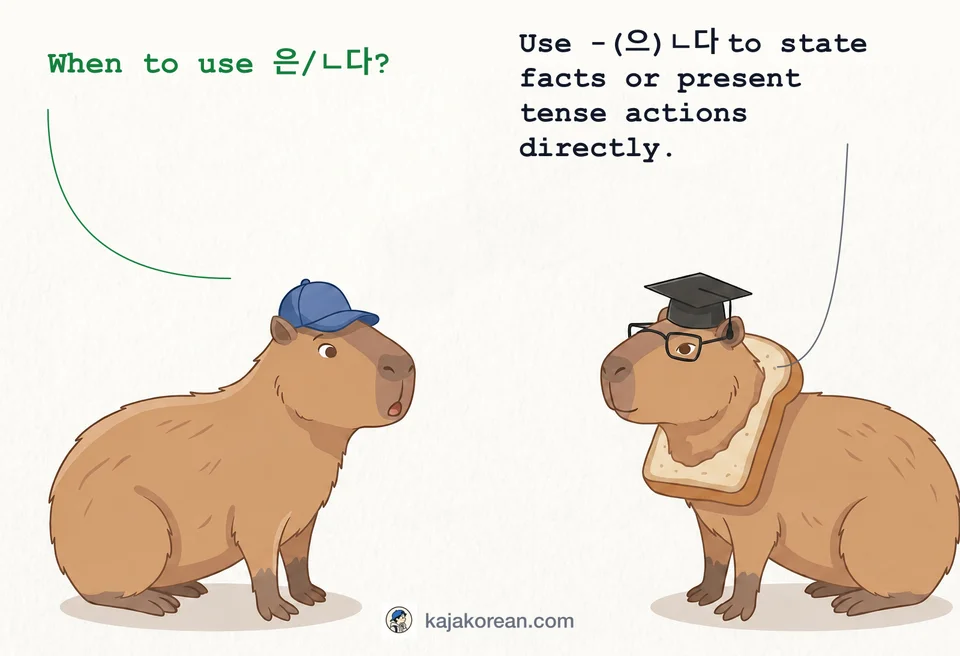
How to use 은/ㄴ다 in Korean

Pattern: -(으)ㄴ다

-(으)ㄴ다 (-(eu)ㄴda, (eu)ㄴda)

-(으)ㄴ다 is a Korean present tense declarative ending used to state facts in speech or writing.

Korean grammar -(으)ㄴ다 usage explanation

Usage guide

When and how native speakers actually use it.

-(으)ㄴ다(-(eu)ㄴda, (eu)ㄴda)

A sentence ending used to directly state facts or present situations.

When to use

casual conversation, writing diary, stating facts, writing reports

The nuance

Attach '-는다' if verb stem ends with a consonant, '-ㄴ다' if it ends with a vowel. Used as a declarative ending to state facts directly, mainly with verbs. Not used with nouns or adjectives.

Real-world examples

  • 나는 밥을 먹는다.

    na-neun bap-eul meok-neun-da., na neun bap eul meok neun da.

    Verb stem '먹' ends with a consonant, so '-는다' is attached for present tense.

  • 그는 학교에 간다.

    geu-neun hak-gyo-e gan-da., geu neun hak gyo e gan da.

    Verb stem '가' ends with a vowel, so '-ㄴ다' is attached for present tense.

  • 나는 예쁘다.

    na-neun ye-ppeu-da., na neun ye ppeu da.

    Adjectives do not take -(으)ㄴ다; use '-다' instead.

  • 책이 재미있다.

    chaek-i jae-mi-iss-da., chaek i jae mi iss da.

    Not used with nouns or adjectives.

  • 비가 온다.

    bi-ga on-da., bi ga on da.

    Verb stem '오' ends with vowel, so '-ㄴ다' is attached.

Quick quiz

  1. Which sentence correctly uses -(으)ㄴ다?

    다음 중 -(으)ㄴ다를 올바르게 쓴 문장은?(da-eumjung-(eu)ㄴda-reulol-ba-reu-gesseunmun-jang-eun?, daeumjung(eu)ㄴdareulolbareugesseunmunjangeun?)
  2. Which sentence cannot use -(으)ㄴ다?

    다음 중 -(으)ㄴ다를 사용할 수 없는 문장은?(da-eumjung-(eu)ㄴda-reulsa-yong-halsueop-neunmun-jang-eun?, daeumjung(eu)ㄴdareulsayonghalsueopneunmunjangeun?)

More usage guides

View all usage guides →