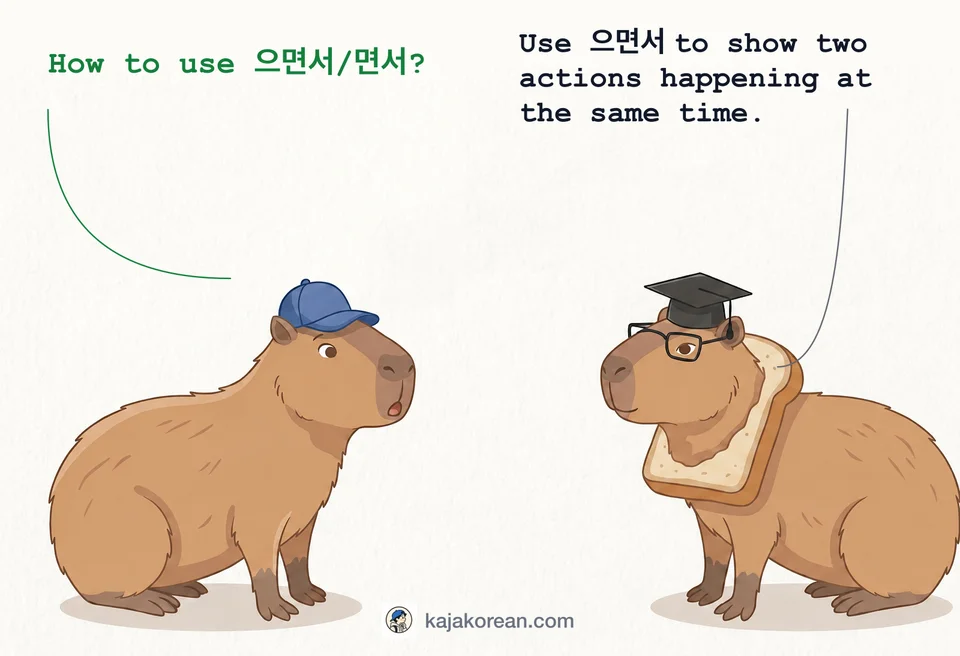
How to use 으면서/면서 in Korean

Pattern: -(으)면서

-(으)면서 (-(eu)myeon-seo, (eu)myeonseo)

-(으)면서 expresses two actions or states happening simultaneously. Essential for natural Korean connections.

Korean grammar 으면서 showing simultaneous actions

Usage guide

When and how native speakers actually use it.

-(으)면서(-(eu)myeon-seo, (eu)myeonseo)

A connective ending indicating simultaneous actions or states

When to use

Expressing simultaneous actions, Describing habits, Mentioning two states at once

The nuance

Attach -(으)면서 to verb or adjective stems to indicate two actions or states occur simultaneously. Use '-으면서' if stem ends with a consonant, '-면서' if vowel. The subject must be the same for both actions. Commonly used for ongoing or habitual actions.

Real-world examples

  • 음악을 들으면서 공부해요.

    eum-ak-eul deul-eu-myeon-seo gong-bu-hae-yo., eum ak eul deul eu myeon seo gong bu hae yo.

    The subject is the same and two actions occur simultaneously, so it's correct.

  • 친구가 말하면서 저는 듣고 있어요.

    chin-gu-ga mal-ha-myeon-seo jeo-neun deut-go iss-eo-yo., chin gu ga mal ha myeon seo jeo neun deut go iss eo yo.

    Subjects differ, so -(으)면서 cannot be used.

  • 밥을 먹으면서 TV를 봐요.

    bap-eul meok-eu-myeon-seo tvreul bwa-yo., bap eul meok eu myeon seo tvreul bwa yo.

    Same subject and simultaneous actions make it natural.

  • 비가 오면서 춥다.

    bi-ga o-myeon-seo chup-da., bi ga o myeon seo chup da.

    Two states occur simultaneously, so -(으)면서 is appropriate.

  • 책을 읽으면서 친구를 만나요.

    chaek-eul ik-eu-myeon-seo chin-gu-reul man-na-yo., chaek eul ik eu myeon seo chin gu reul man na yo.

    The two actions are unlikely to happen simultaneously, so it's unnatural.

  • 노래를 부르면서 춤을 춰요.

    no-rae-reul bu-reu-myeon-seo chum-eul chwo-yo., no rae reul bu reu myeon seo chum eul chwo yo.

    Same subject and simultaneous actions, so it's correct.

Quick quiz

  1. Which sentence correctly uses -(으)면서?

    다음 중 -(으)면서를 올바르게 사용한 문장은?(da-eumjung-(eu)myeon-seo-reulol-ba-reu-gesa-yong-hanmun-jang-eun?, daeumjung(eu)myeonseoreulolbareugesayonghanmunjangeun?)
  2. What does -(으)면서 indicate?

    -(으)면서가 의미하는 것은?(-(eu)myeon-seo-gaui-mi-ha-neungeos-eun?, (eu)myeonseogauimihaneungeoseun?)
  3. Which sentence is incorrect?

    다음 중 틀린 문장은?(da-eumjungteul-rinmun-jang-eun?, daeumjungteulrinmunjangeun?)

More usage guides

View all usage guides →