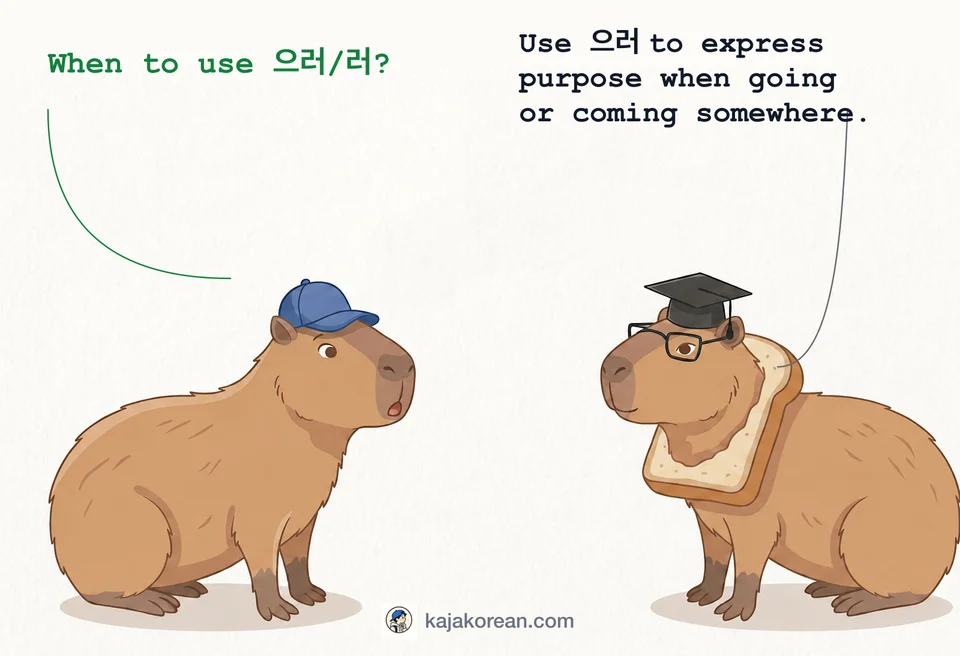
How to use 으러/러 in Korean

Pattern: -(으)러

-(으)러 (-(eu)reo, (eu)reo)

-(으)러 expresses purpose, used like 'go/come to do something' in Korean.

Explanation of Korean grammar 으러

Usage guide

When and how native speakers actually use it.

-(으)러(-(eu)reo, (eu)reo)

Indicates going or coming somewhere for a purpose.

When to use

expressing purpose, movement situations, daily conversation

The nuance

Attach to verb stem: use '-으러' if stem ends with a consonant, '-러' if it ends with a vowel. Used mainly with '가다' or '오다' to indicate purpose.

Real-world examples

  • 학교에 공부하러 가요.

    hak-gyo-e gong-bu-ha-reo ga-yo., hak gyo e gong bu ha reo ga yo.

    Verb stem '공부하' ends with a vowel, so '-러' is used. Combined with '가다' to express purpose correctly.

  • 시장에 장을 보러 왔어요.

    si-jang-e jang-eul bo-reo wass-eo-yo., si jang e jang eul bo reo wass eo yo.

    Verb stem '보' ends with a vowel, so '-러' is used. Used with '오다' to indicate purpose correctly.

  • 친구를 만나러 학교에 가요.

    chin-gu-reul man-na-reo hak-gyo-e ga-yo., chin gu reul man na reo hak gyo e ga yo.

    Verb stem '만나' ends with a vowel, so '-러' is used. Properly expresses purpose and movement.

  • 운동하러 공원에 갑니다.

    un-dong-ha-reo gong-won-e gap-ni-da., un dong ha reo gong won e gap ni da.

    Verb stem '운동하' ends with a vowel, so '-러' is used. Correctly pairs with '가다' for purpose.

  • 책을 읽으러 도서관에 가요.

    chaek-eul ik-eu-reo do-seo-gwan-e ga-yo., chaek eul ik eu reo do seo gwan e ga yo.

    Verb stem '읽' ends with a consonant, so '-으러' is used. Combined with '가다' to show purpose.

  • 밥을 먹으러 식당에 왔어요.

    bap-eul meok-eu-reo sik-dang-e wass-eo-yo., bap eul meok eu reo sik dang e wass eo yo.

    Verb stem '먹' ends with a consonant, so '-으러' is used. Properly used with '오다' for purpose.

  • 영화를 보러 극장에 갑니다.

    yeong-hwa-reul bo-reo geuk-jang-e gap-ni-da., yeong hwa reul bo reo geuk jang e gap ni da.

    Verb stem '보' ends with a vowel, so '-러' is used. Correctly used with '가다' for purpose.

  • 친구를 만나러 집에 왔어요.

    chin-gu-reul man-na-reo jip-e wass-eo-yo., chin gu reul man na reo jip e wass eo yo.

    Verb stem '만나' ends with a vowel, so '-러' is used. Properly used with '오다' to indicate purpose.

Quick quiz

  1. Which sentence correctly uses -(으)러?

    다음 중 -(으)러를 올바르게 사용한 문장은?(da-eumjung-(eu)reo-reulol-ba-reu-gesa-yong-hanmun-jang-eun?, daeumjung(eu)reoreulolbareugesayonghanmunjangeun?)
  2. Choose the correct form of -(으)러 in: "친구를 만나__ 학교에 갑니다."

    -(으)러가 다음 문장에서 올바른 형태는? "친구를 만나__ 학교에 갑니다."(-(eu)reo-gada-eummun-jang-e-seool-ba-reunhyeong-tae-neun?"chin-gu-reulman-na__hak-gyo-egap-ni-da.", (eu)reogadaeummunjangeseoolbareunhyeongtaeneun?"chingureulmanna__hakgyoegapnida.")
  3. Which sentence is incorrect?

    다음 중 틀린 문장은?(da-eumjungteul-rinmun-jang-eun?, daeumjungteulrinmunjangeun?)

More usage guides

View all usage guides →