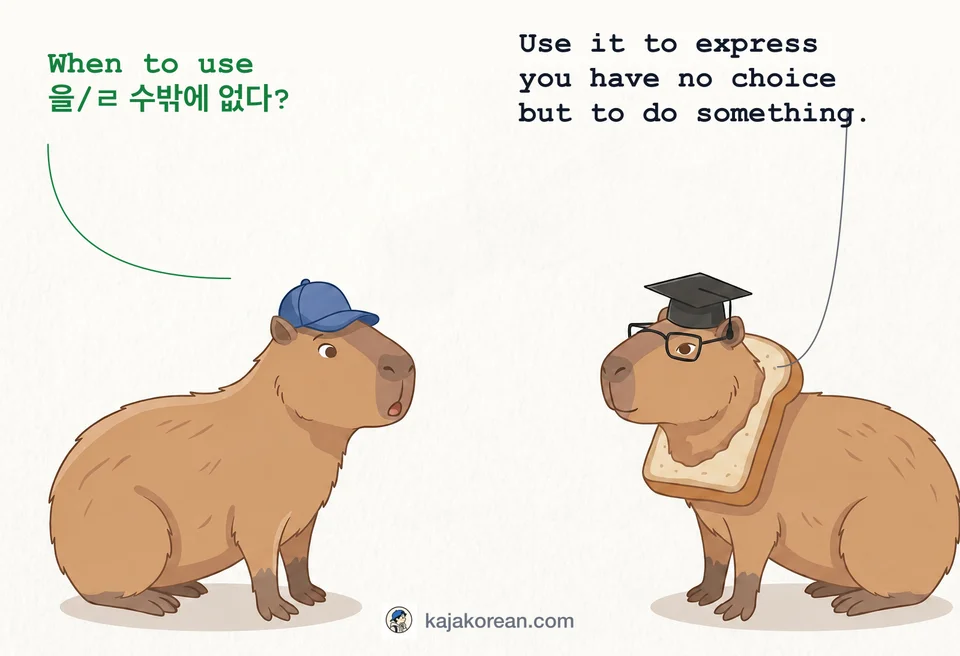
How to use 을/ㄹ 수밖에 없다 in Korean

Pattern: -(으)ㄹ 수밖에 없다

-(으)ㄹ 수밖에 없다 (-(eu)ㄹsu-bakk-eeop-da, (eu)ㄹsubakkeeopda)

-(으)ㄹ 수밖에 없다 expresses inevitability when you have no choice but to do something.

Usage of -(으)ㄹ 수밖에 없다 in Korean grammar

Usage guide

When and how native speakers actually use it.

-(으)ㄹ 수밖에 없다(-(eu)ㄹsu-bakk-eeop-da, (eu)ㄹsubakkeeopda)

Indicates there is no other choice but to do something due to circumstances

When to use

Inevitable decision, Inevitable result, Emphasizing no alternative

The nuance

Attach to verb or adjective stems in future or speculative form as ‘~할 수밖에 없다’. Used to express unavoidable or inevitable situations.

Real-world examples

  • 내일 비가 올 수밖에 없어요.

    nae-il bi-ga ol su-bakk-e eop-eo-yo., nae il bi ga ol su bakk e eop eo yo.

    ‘올 수밖에 없다’ shows the inevitability of rain tomorrow.

  • 그는 거짓말을 할 수밖에 없었다.

    geu-neun geo-jis-mal-eul hal su-bakk-e eop-eoss-da., geu neun geo jis mal eul hal su bakk e eop eoss da.

    ‘할 수밖에 없었다’ means lying was unavoidable.

  • 너는 그 일을 하지 않을 수밖에 없다.

    neo-neun geu il-eul ha-ji an-eul su-bakk-e eop-da., neo neun geu il eul ha ji an eul su bakk e eop da.

    Negative form with ‘수밖에 없다’ is unnatural here.

  • 우리는 계획을 변경할 수밖에 없어요.

    u-ri-neun gye-hoek-eul byeon-gyeong-hal su-bakk-e eop-eo-yo., u ri neun gye hoek eul byeon gyeong hal su bakk e eop eo yo.

    ‘변경할 수밖에 없다’ indicates plan change is inevitable.

  • 그녀는 시험에 합격할 수밖에 없어요.

    geu-nyeo-neun si-heom-e hap-gyeok-hal su-bakk-e eop-eo-yo., geu nyeo neun si heom e hap gyeok hal su bakk e eop eo yo.

    Used for inevitability, not mere speculation.

  • 교통 체증 때문에 지각할 수밖에 없었어요.

    gyo-tong che-jeung ttae-mun-e ji-gak-hal su-bakk-e eop-eoss-eo-yo., gyo tong che jeung ttae mun e ji gak hal su bakk e eop eoss eo yo.

    Expresses unavoidable lateness due to traffic.

Quick quiz

  1. Which sentence correctly uses ‘-(으)ㄹ 수밖에 없다’?

    다음 중 ‘-(으)ㄹ 수밖에 없다’가 올바르게 사용된 문장은?(da-eumjung‘-(eu)ㄹsu-bakk-eeop-da’gaol-ba-reu-gesa-yong-doenmun-jang-eun?, daeumjung‘(eu)ㄹsubakkeeopda’gaolbareugesayongdoenmunjangeun?)
  2. What does ‘-(으)ㄹ 수밖에 없다’ mean?

    ‘-(으)ㄹ 수밖에 없다’의 의미는?(‘-(eu)ㄹsu-bakk-eeop-da’uiui-mi-neun?, ‘(eu)ㄹsubakkeeopda’uiuimineun?)
  3. What is the role of ‘-(으)ㄹ 수밖에 없다’ in ‘He had no choice but to give up the work.’?

    ‘그는 그 일을 포기할 수밖에 없었다.’에서 ‘-(으)ㄹ 수밖에 없다’의 역할은?(‘geu-neungeuil-eulpo-gi-halsu-bakk-eeop-eoss-da.’e-seo‘-(eu)ㄹsu-bakk-eeop-da’uiyeok-hal-eun?, ‘geuneungeuileulpogihalsubakkeeopeossda.’eseo‘(eu)ㄹsubakkeeopda’uiyeokhaleun?)

More usage guides

View all usage guides →