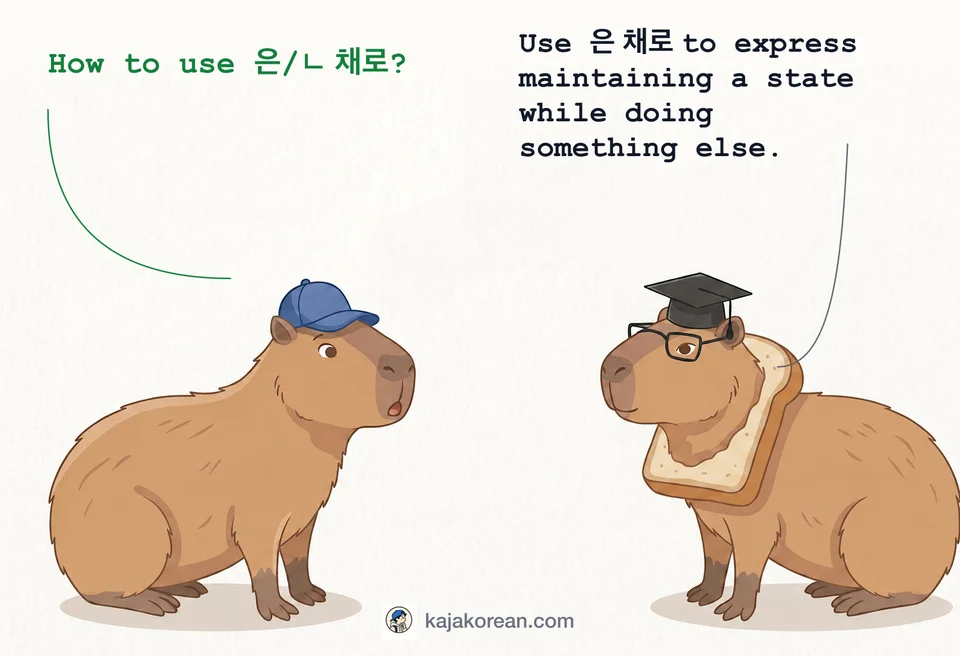
How to use 은/ㄴ 채로 in Korean

Pattern: -(으)ㄴ 채로

-(으)ㄴ 채로 (-(eu)ㄴchae-ro, (eu)ㄴchaero)

-(으)ㄴ 채로 expresses doing something while maintaining a certain state.

Example of Korean grammar 은 채로 usage

Usage guide

When and how native speakers actually use it.

-(으)ㄴ 채로(-(eu)ㄴchae-ro, (eu)ㄴchaero)

Indicates continuing an action or situation while maintaining a certain state.

When to use

state maintenance, simultaneous actions, emphasizing state during action

The nuance

Attach -(으)ㄴ 채로 to the past tense form of verbs or adjectives. It is used when an action continues while maintaining the previous state. Example: 문을 연 채로 방에 들어갔다 (entered the room while the door remained open).

Real-world examples

  • 창문을 연 채로 잠들었어요.

    chang-mun-eul yeon chae-ro jam-deul-eoss-eo-yo., chang mun eul yeon chae ro jam deul eoss eo yo.

    Correctly expresses falling asleep while the window remains open.

  • 신발을 신은 채로 방에 들어갔어요.

    sin-bal-eul sin-eun chae-ro bang-e deul-eo-gass-eo-yo., sin bal eul sin eun chae ro bang e deul eo gass eo yo.

    Clearly indicates entering the room while still wearing shoes.

  • 음악을 켠 채로 공부했어요.

    eum-ak-eul kyeon chae-ro gong-bu-haess-eo-yo., eum ak eul kyeon chae ro gong bu haess eo yo.

    Accurately expresses studying while the music remains on.

  • 책을 읽은 채로 잠들었어요.

    chaek-eul ik-eun chae-ro jam-deul-eoss-eo-yo., chaek eul ik eun chae ro jam deul eoss eo yo.

    Incorrect because the state of having read a book cannot be maintained; '-는 채로' is correct.

  • 문을 닫은 채로 나갔어요.

    mun-eul dat-eun chae-ro na-gass-eo-yo., mun eul dat eun chae ro na gass eo yo.

    Naturally expresses leaving while the door remains closed.

  • 음식을 먹은 채로 운동했어요.

    eum-sik-eul meok-eun chae-ro un-dong-haess-eo-yo., eum sik eul meok eun chae ro un dong haess eo yo.

    Incorrect because the state of having eaten is not maintained; this does not express sequence properly.

Quick quiz

  1. Which sentence correctly uses -(으)ㄴ 채로?

    다음 중 -(으)ㄴ 채로를 올바르게 사용한 문장은?(da-eumjung-(eu)ㄴchae-ro-reulol-ba-reu-gesa-yong-hanmun-jang-eun?, daeumjung(eu)ㄴchaeroreulolbareugesayonghanmunjangeun?)
  2. What does -(으)ㄴ 채로 mean?

    -(으)ㄴ 채로의 의미는 무엇인가요?(-(eu)ㄴchae-ro-uiui-mi-neunmu-eos-in-ga-yo?, (eu)ㄴchaerouiuimineunmueosingayo?)
  3. Which sentence is incorrect?

    다음 중 틀린 문장은?(da-eumjungteul-rinmun-jang-eun?, daeumjungteulrinmunjangeun?)

More usage guides

View all usage guides →