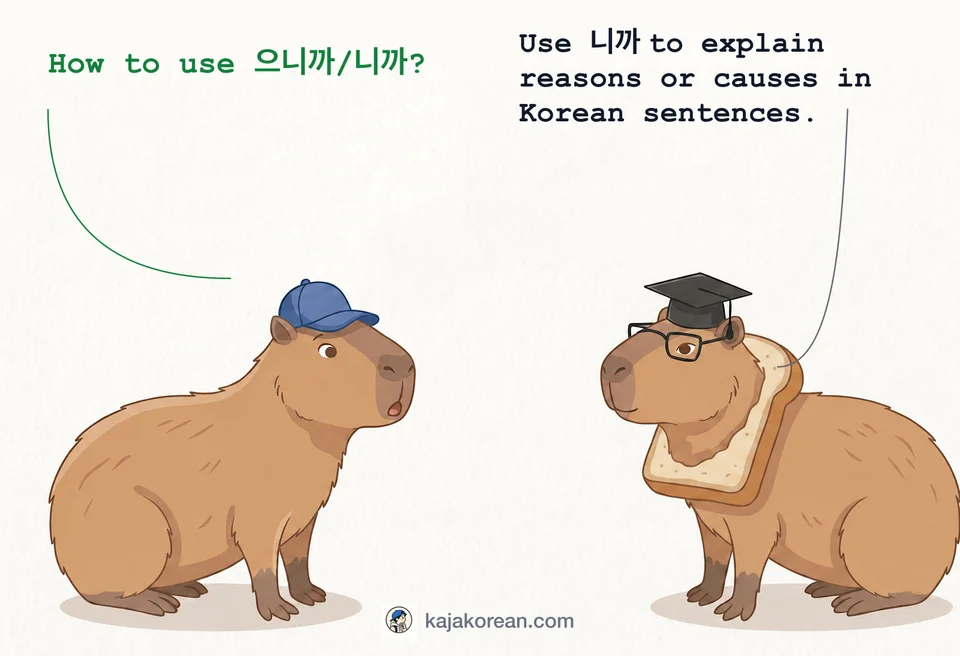
How to use 으니까/니까 in Korean

Pattern: -(으)니까

-(으)니까 (-(eu)ni-kka, (eu)nikka)

-(으)니까 is a connective ending that expresses reason or cause, linking the first clause as the basis for the second.

Explanation of the Korean connective 니까

Usage guide

When and how native speakers actually use it.

-(으)니까(-(eu)ni-kka, (eu)nikka)

A connective ending indicating cause or reason from the first clause

When to use

explaining reasons, stating causes, giving advice or commands with reasons

The nuance

Attach -(으)니까 to the verb or adjective stem to indicate cause or reason. Use '-으니까' if the stem ends with a consonant, '-니까' if it ends with a vowel. It mainly expresses reasons based on the speaker's direct experience or judgment.

Real-world examples

  • 비가 오니까 우산을 가져가세요.

    bi-ga o-ni-kka u-san-eul ga-jyeo-ga-se-yo., bi ga o ni kka u san eul ga jyeo ga se yo.

    The reason in the first clause (it's raining) justifies the action in the second (take an umbrella).

  • 피곤하니까 일찍 자요.

    pi-gon-ha-ni-kka il-jjik ja-yo., pi gon ha ni kka il jjik ja yo.

    Clearly indicates tiredness as the reason for sleeping early.

  • 밥 먹으니까 배가 고파요.

    bap meok-eu-ni-kka bae-ga go-pa-yo., bap meok eu ni kka bae ga go pa yo.

    You cannot be hungry because you ate; cause and effect are illogical.

  • 늦었으니까 빨리 가야 해요.

    neuj-eoss-eu-ni-kka ppal-ri ga-ya hae-yo., neuj eoss eu ni kka ppal ri ga ya hae yo.

    The lateness provides a reason to go quickly.

  • 공부하니까 시험에 합격했어요.

    gong-bu-ha-ni-kka si-heom-e hap-gyeok-haess-eo-yo., gong bu ha ni kka si heom e hap gyeok haess eo yo.

    Studying is clearly expressed as the cause of passing the exam.

  • 춥니까 문을 닫으세요.

    chup-ni-kka mun-eul dat-eu-se-yo., chup ni kka mun eul dat eu se yo.

    -(으)니까 is not used for conditional sentences, but for reasons.

Quick quiz

  1. Which sentence correctly uses -(으)니까?

    다음 중 -(으)니까를 올바르게 사용한 문장은?(da-eumjung-(eu)ni-kka-reulol-ba-reu-gesa-yong-hanmun-jang-eun?, daeumjung(eu)nikkareulolbareugesayonghanmunjangeun?)
  2. What does -(으)니까 mean in "피곤하니까 일찍 자요."?

    "피곤하니까 일찍 자요." 문장에서 -(으)니까의 의미는?("pi-gon-ha-ni-kkail-jjikja-yo."mun-jang-e-seo-(eu)ni-kka-uiui-mi-neun?, "pigonhanikkailjjikjayo."munjangeseo(eu)nikkauiuimineun?)
  3. Which sentence is incorrect?

    다음 중 틀린 문장은?(da-eumjungteul-rinmun-jang-eun?, daeumjungteulrinmunjangeun?)

More usage guides

View all usage guides →