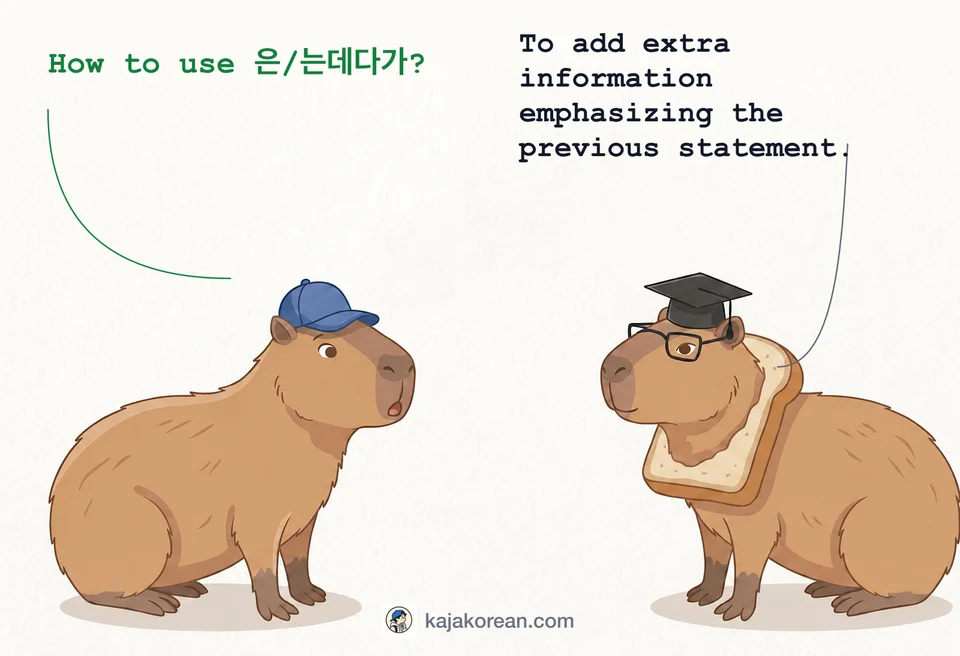
How to use 은/는데다가 in Korean

Pattern: -(으)ㄴ/는데다가

-(으)ㄴ/는데다가 (-(eu)ㄴ, (eu)ㄴ, neun-de-da-ga, neundedaga)

-(으)ㄴ/는데다가 is a connective ending used to add extra information based on the previous sentence.

Korean grammar -(으)ㄴ/는데다가 usage explanation

Usage guide

When and how native speakers actually use it.

-(으)ㄴ/는데다가(-(eu)ㄴ, (eu)ㄴ, neun-de-da-ga, neundedaga)

Used to add additional information or circumstances following the previous sentence.

When to use

Adding extra information, Explaining situation, Emphasizing

The nuance

Attach -(으)ㄴ/는데다가 to adjectives or verbs in past or present tense to add more information or circumstances based on the previous sentence. Use -(으)ㄴ데다가 after adjectives and past tense verbs, and -는데다가 after verbs in present tense. It emphasizes additional positive or negative content.

Real-world examples

  • 그 식당은 맛있는데다가 가격도 저렴해요.

    geu sik-dang-eun mas-iss-neun-de-da-ga ga-gyeok-do jeo-ryeom-hae-yo., geu sik dang eun mas iss neun de da ga ga gyeok do jeo ryeom hae yo.

    Added -는데다가 to the adjective '맛있다' in present tense to add extra info.

  • 그 영화는 재미있는데다가 감동적이었어요.

    geu yeong-hwa-neun jae-mi-iss-neun-de-da-ga gam-dong-jeok-i-eoss-eo-yo., geu yeong hwa neun jae mi iss neun de da ga gam dong jeok i eoss eo yo.

    Used -는데다가 after past tense adjective for additional info.

  • 그 사람은 똑똑한데다가 성격도 좋아요.

    geu sa-ram-eun ttok-ttok-han-de-da-ga seong-gyeok-do joh-a-yo., geu sa ram eun ttok ttok han de da ga seong gyeok do joh a yo.

    Added -는데다가 to present tense adjective to explain additional situation.

  • 날씨가 추운데다가 바람도 많이 불어요.

    nal-ssi-ga chu-un-de-da-ga ba-ram-do man-i bul-eo-yo., nal ssi ga chu un de da ga ba ram do man i bul eo yo.

    Connected two situations by adding -는데다가 to present tense adjective.

  • 그는 열심히 공부했는데다가 아르바이트도 했어요.

    geu-neun yeol-sim-hi gong-bu-haess-neun-de-da-ga a-reu-ba-i-teu-do haess-eo-yo., geu neun yeol sim hi gong bu haess neun de da ga a reu ba i teu do haess eo yo.

    Added -는데다가 to past tense verb to add another action.

  • 그 집은 크고 깨끗한데다가 위치도 좋아요.

    geu jip-eun keu-go kkae-kkeus-han-de-da-ga wi-chi-do joh-a-yo., geu jip eun keu go kkae kkeus han de da ga wi chi do joh a yo.

    Connected two adjectives and added -는데다가 to add location info.

  • 그 사람은 친절한데다가 유머도 있어요.

    geu sa-ram-eun chin-jeol-han-de-da-ga yu-meo-do iss-eo-yo., geu sa ram eun chin jeol han de da ga yu meo do iss eo yo.

    Added -는데다가 to adjective to add positive additional trait.

  • 오늘은 바쁜데다가 피곤하기도 해요.

    o-neul-eun ba-ppeun-de-da-ga pi-gon-ha-gi-do hae-yo., o neul eun ba ppeun de da ga pi gon ha gi do hae yo.

    Added -는데다가 to present tense adjective to add another state.

Quick quiz

  1. Which sentence correctly uses -(으)ㄴ/는데다가?

    다음 중 -(으)ㄴ/는데다가를 올바르게 사용한 문장은?(da-eumjung-(eu)ㄴ, daeumjung(eu)ㄴ, neun-de-da-ga-reulol-ba-reu-gesa-yong-hanmun-jang-eun?, neundedagareulolbareugesayonghanmunjangeun?)
  2. Which sentence is incorrect?

    다음 중 틀린 문장은?(da-eumjungteul-rinmun-jang-eun?, daeumjungteulrinmunjangeun?)

More usage guides

View all usage guides →