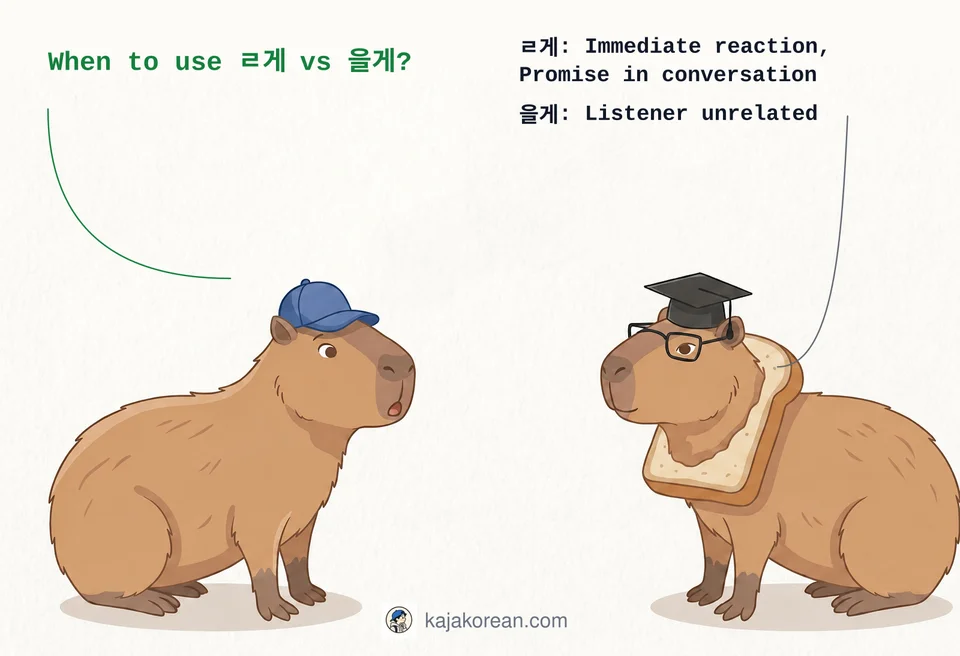
ㄹ게 vs 을게: Comparing Promise and Intention Expressions

ㄹ게 (ㄹge) · 을게 (eul-ge, eulge)

Both ㄹ게 and 을게 express future intention, but ㄹ게 focuses on promises or consideration towards others, while 을게 emphasizes the speaker's determination or resolve.

Comparison of Korean future intention endings ㄹ게 and 을게

Word-by-word breakdown

One lane per word — no nested boxes, just the gist.

ㄹ게(ㄹge)

Future intention expressing a promise or consideration towards the listener

When to use

Listener consideration promise, Promise in conversation, Immediate reaction

The nuance

Used mainly in response to the listener's actions or situation, expressing the speaker's consideration or promise to the listener.

을게(eul-ge, eulge)

Future intention expressing the speaker's determination or resolve

When to use

Speaker determination intention, Independent intention expression, Listener unrelated

The nuance

Used when the speaker expresses their own will or determination, independently of the listener's actions.

Real-world examples

  • 내일 일찍 올게.

    nae-il il-jjik ol-ge., nae il il jjik ol ge.

    Appropriate as a promise to the listener, ㄹ게 fits well.

  • 내일 일찍 을게.

    nae-il il-jjik eul-ge., nae il il jjik eul ge.

    을게 expresses independent intention, but this sentence is a promise context, so ㄹ게 is correct.

  • 비가 오니까 우산 챙길게.

    bi-ga o-ni-kka u-san chaeng-gil-ge., bi ga o ni kka u san chaeng gil ge.

    Responding to listener's situation with consideration, ㄹ게 is appropriate.

  • 비가 오니까 우산 챙길을게.

    bi-ga o-ni-kka u-san chaeng-gil-eul-ge., bi ga o ni kka u san chaeng gil eul ge.

    을게 is for independent intention, so inappropriate for immediate reactive promises.

  • 이번 프로젝트는 내가 맡을게.

    i-beon peu-ro-jek-teu-neun nae-ga mat-eul-ge., i beon peu ro jek teu neun nae ga mat eul ge.

    Expressing promise or consideration to listener, ㄹ게 is correct.

  • 이번 프로젝트는 내가 맡을을게.

    i-beon peu-ro-jek-teu-neun nae-ga mat-eul-eul-ge., i beon peu ro jek teu neun nae ga mat eul eul ge.

    Though 을게 shows determination, this is a promise to listener, so ㄹ게 fits.

  • 내가 할게.

    nae-ga hal-ge., nae ga hal ge.

    The most common expression for immediate promise or consideration.

  • 내가 할을게.

    nae-ga hal-eul-ge., nae ga hal eul ge.

    을게 is independent determination, but this is a promise context, so incorrect.

Quick quiz

  1. Which is appropriate to express a promise or consideration to the listener?

    다음 중 상대방에게 약속하거나 배려를 표현할 때 적절한 표현은?(da-eumjungsang-dae-bang-e-geyak-sok-ha-geo-nabae-ryeo-reulpyo-hyeon-halttaejeok-jeol-hanpyo-hyeon-eun?, daeumjungsangdaebangegeyaksokhageonabaeryeoreulpyohyeonhalttaejeokjeolhanpyohyeoneun?)
  2. Which is used to emphasize the speaker's independent intention?

    화자의 독립적인 의지를 강조할 때 사용하는 표현은?(hwa-ja-uidok-rip-jeok-inui-ji-reulgang-jo-halttaesa-yong-ha-neunpyo-hyeon-eun?, hwajauidokripjeokinuijireulgangjohalttaesayonghaneunpyohyeoneun?)
  3. What is the function of the expression in "내가 할게"?

    "내가 할게" 문장에서 사용된 표현의 용도는?("nae-gahal-ge"mun-jang-e-seosa-yong-doenpyo-hyeon-uiyong-do-neun?, "naegahalge"munjangeseosayongdoenpyohyeonuiyongdoneun?)

More comparisons to explore

View all word comparisons →