
가능(ga-neung, ganeung)
Indicates that something can be done or is feasible.
When to use
feasibility, permission granted, ability present
The nuance
Use when something can actually be executed or achieved. Expresses positive possibility.
가능 (ga-neung, ganeung) · 불가능 (bul-ga-neung, bulganeung) · 어려움 (eo-ryeo-um, eoryeoum)
가능 (ganeung) means something can be done, 불가능 (bulganeung) means it cannot be done, and 어려움 (eoryeoum) means it is difficult but not impossible.
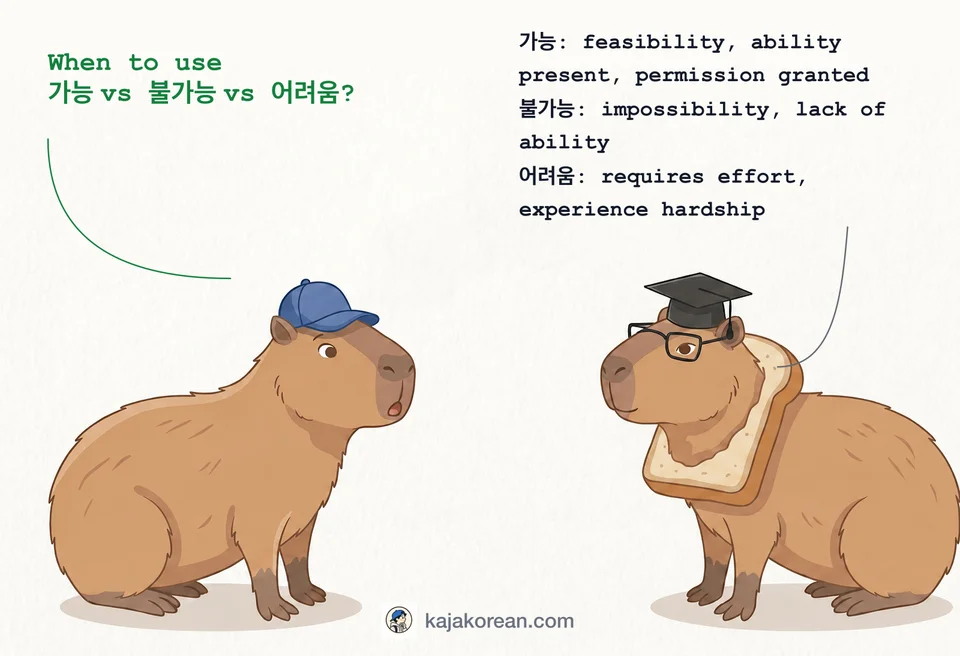
One lane per word — no nested boxes, just the gist.
Indicates that something can be done or is feasible.
When to use
feasibility, permission granted, ability present
The nuance
Use when something can actually be executed or achieved. Expresses positive possibility.
Indicates that something cannot be done or is impossible.
When to use
impossibility, permission denied, lack of ability
The nuance
Use when something is physically, situationally, or logically impossible. Expresses negative possibility.
Indicates that something is difficult or challenging but not completely impossible.
When to use
presence of obstacles, experience hardship, requires effort
The nuance
Use when something is feasible but has obstacles or challenges. Emphasizes difficulty or hardship.
이 프로젝트는 가능해요.
i peu-ro-jek-teu-neun ga-neung-hae-yo., i peu ro jek teu neun ga neung hae yo.
The project can be executed, so '가능' is appropriate.
이 프로젝트는 불가능해요.
i peu-ro-jek-teu-neun bul-ga-neung-hae-yo., i peu ro jek teu neun bul ga neung hae yo.
The project cannot be executed, so '불가능' is appropriate.
이 프로젝트는 어려움이에요.
i peu-ro-jek-teu-neun eo-ryeo-um-i-e-yo., i peu ro jek teu neun eo ryeo um i e yo.
'어려움' is a noun and can't directly modify '프로젝트.' Use '어렵다' or '어려움이 있다' instead.
이 문제는 어려움이 많아요.
i mun-je-neun eo-ryeo-um-i man-a-yo., i mun je neun eo ryeo um i man a yo.
Using '어려움' to express many challenges in a problem is appropriate.
시험 합격은 가능하지만 어려움이 많아요.
si-heom hap-gyeok-eun ga-neung-ha-ji-man eo-ryeo-um-i man-a-yo., si heom hap gyeok eun ga neung ha ji man eo ryeo um i man a yo.
Combining '가능' and '어려움' properly expresses feasibility with difficulty.
시험 합격은 불가능하지만 어려움이 많아요.
si-heom hap-gyeok-eun bul-ga-neung-ha-ji-man eo-ryeo-um-i man-a-yo., si heom hap gyeok eun bul ga neung ha ji man eo ryeo um i man a yo.
If something is impossible, saying it is difficult is contradictory.
그 일은 가능하지 않아요.
geu il-eun ga-neung-ha-ji an-a-yo., geu il eun ga neung ha ji an a yo.
Using '가능하지 않다' to express inability is appropriate.
그 일은 어려움하지 않아요.
geu il-eun eo-ryeo-um-ha-ji an-a-yo., geu il eun eo ryeo um ha ji an a yo.
'어려움' is a noun and cannot combine with '-하지 않다.' Use '어렵지 않다' instead.
Which sentence best uses '불가능'?
Which sentence correctly uses '어려움'?
Which sentence cannot use '가능'?