
고소하다(go-so-ha-da, gosohada)
To legally file a complaint or accuse someone
When to use
complainant, legal accusation, active subject
The nuance
고소하다 means the subject actively files a legal complaint against someone else. The subject is the accuser.
고소하다 (go-so-ha-da, gosohada) · 고소되다 (go-so-doe-da, gosodoeda)
고소하다 (gosohada) means to file a complaint, while 고소되다 (gosodoeda) means to be accused or have a complaint filed against you.
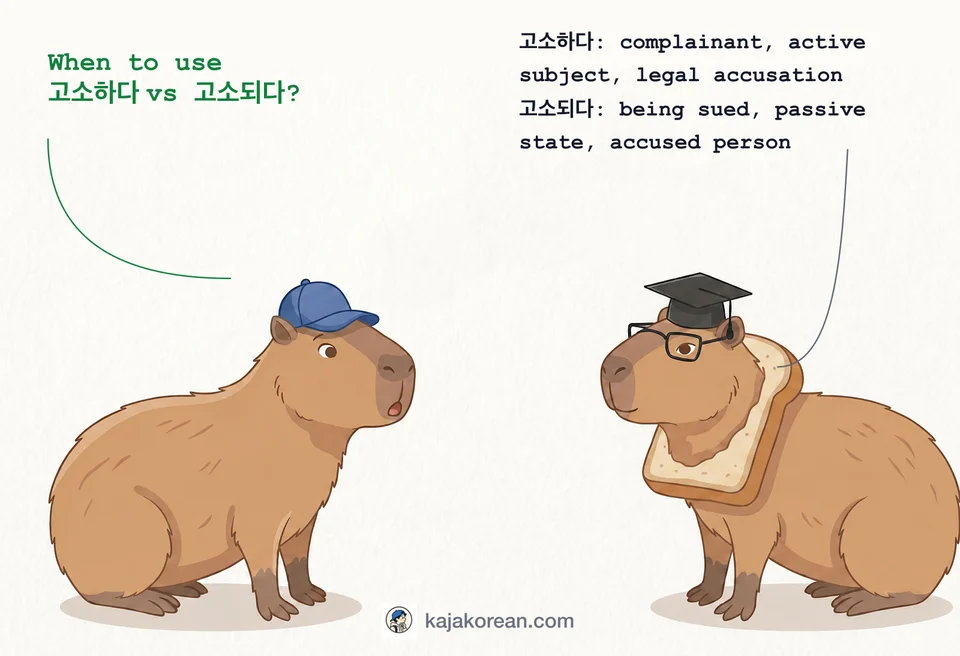
One lane per word — no nested boxes, just the gist.
To legally file a complaint or accuse someone
When to use
complainant, legal accusation, active subject
The nuance
고소하다 means the subject actively files a legal complaint against someone else. The subject is the accuser.
To be legally accused or have a complaint filed against oneself
When to use
accused person, passive state, being sued
The nuance
고소되다 expresses the passive state of being accused. The subject is the accused person.
나는 그를 고소했다.
na-neun geu-reul go-so-haess-da., na neun geu reul go so haess da.
The subject is the one filing the complaint, so this sentence is correct.
나는 그에게 고소되었다.
na-neun geu-e-ge go-so-doe-eoss-da., na neun geu e ge go so doe eoss da.
Correct because the subject is the one being accused.
그가 나를 고소되었다.
geu-ga na-reul go-so-doe-eoss-da., geu ga na reul go so doe eoss da.
Incorrect because 고소되다 requires the subject to be the accused, not the accuser.
그녀가 나를 고소했다.
geu-nyeo-ga na-reul go-so-haess-da., geu nyeo ga na reul go so haess da.
Correct because the subject is the accuser.
나는 그에게 고소했다.
na-neun geu-e-ge go-so-haess-da., na neun geu e ge go so haess da.
Incorrect because 고소하다 is active and the subject must be the accuser.
그는 고소되었다.
geu-neun go-so-doe-eoss-da., geu neun go so doe eoss da.
Correct because the subject is the accused person.
나는 고소되었다.
na-neun go-so-doe-eoss-da., na neun go so doe eoss da.
Correct because the subject is the accused person.
그녀가 고소했다.
geu-nyeo-ga go-so-haess-da., geu nyeo ga go so haess da.
Correct because the subject is the accuser.
Which word is used when someone files a complaint?
Which expression is correct when the accused is the subject?
In '나는 그를 고소했다', who is the subject?