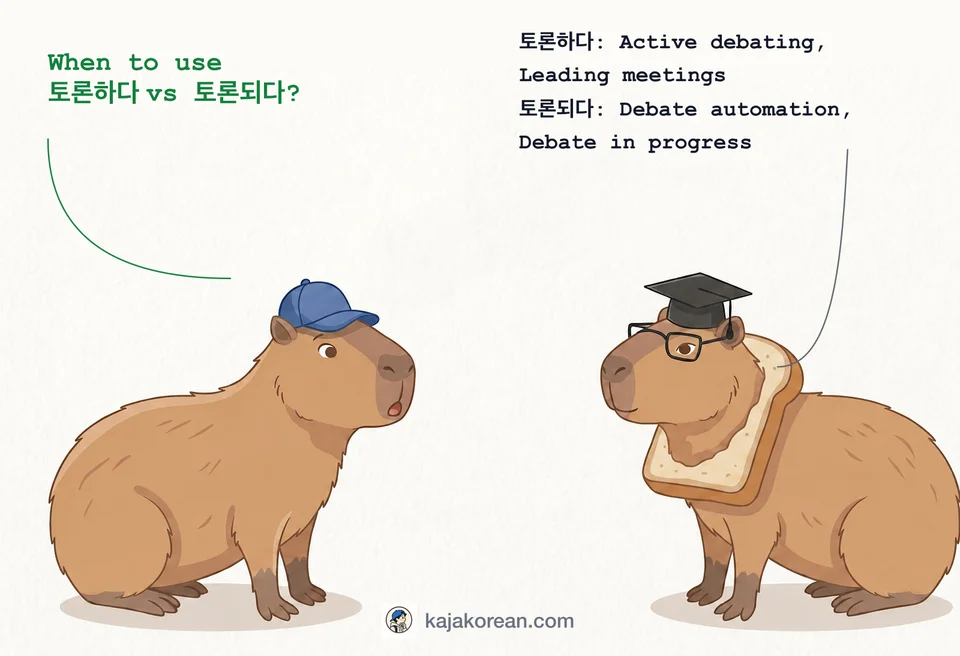
An active act of exchanging opinions and debating directly
When to use
Active debating, Leading meetings, Q&A after presentations
The nuance
Use when the subject actively engages in debating or discussing. It is an active verb.
토론하다 (to-ron-ha-da, toronhada) · 토론되다 (to-ron-doe-da, torondoeda)
토론하다 (toronhada) describes actively debating or discussing, while 토론되다 (torondoeda) expresses that a debate happens or is conducted passively or automatically.

One lane per word — no nested boxes, just the gist.
An active act of exchanging opinions and debating directly
When to use
Active debating, Leading meetings, Q&A after presentations
The nuance
Use when the subject actively engages in debating or discussing. It is an active verb.
Indicates that a debate is happening or being conducted passively or automatically
When to use
Debate in progress, Meeting outcome reporting, Debate automation
The nuance
Use to express that a debate is taking place or is conducted passively. It is a passive verb.
우리는 내일 중요한 주제에 대해 토론한다.
u-ri-neun nae-il jung-yo-han ju-je-e dae-hae to-ron-han-da., u ri neun nae il jung yo han ju je e dae hae to ron han da.
The subject actively debates, so 토론하다 is correct.
회의에서 여러 의견이 토론되었다.
hoe-ui-e-seo yeo-reo ui-gyeon-i to-ron-doe-eoss-da., hoe ui e seo yeo reo ui gyeon i to ron doe eoss da.
Indicates debate happened passively, so 토론되다 is correct.
학생들이 토론되었다.
hak-saeng-deul-i to-ron-doe-eoss-da., hak saeng deul i to ron doe eoss da.
Students cannot be 'debated' passively; they actively debate, so 토론하다 is correct.
그 문제를 토론되었다.
geu mun-je-reul to-ron-doe-eoss-da., geu mun je reul to ron doe eoss da.
It is unnatural for a problem to be 'debated' passively; use 토론하다 for active discussion.
우리는 토론을 통해 해결책을 찾았다.
u-ri-neun to-ron-eul tong-hae hae-gyeol-chaek-eul chaj-ass-da., u ri neun to ron eul tong hae hae gyeol chaek eul chaj ass da.
Active discussion is happening, so use 토론하다.
회의에서 토론되었던 내용이 보고서에 포함되었다.
hoe-ui-e-seo to-ron-doe-eoss-deon nae-yong-i bo-go-seo-e po-ham-doe-eoss-da., hoe ui e seo to ron doe eoss deon nae yong i bo go seo e po ham doe eoss da.
Describes debate occurring passively, so 토론되다 is correct.
우리는 토론되었다.
u-ri-neun to-ron-doe-eoss-da., u ri neun to ron doe eoss da.
People cannot be passively debated; use active 토론하다.
그 주제는 토론되었다.
geu ju-je-neun to-ron-doe-eoss-da., geu ju je neun to ron doe eoss da.
The topic was passively debated, so 토론되다 is correct.
Which sentence expresses actively exchanging opinions?
Which word fits when opinions are passively discussed in a meeting?
Fill in the blank: ‘학생들이 토론____.’