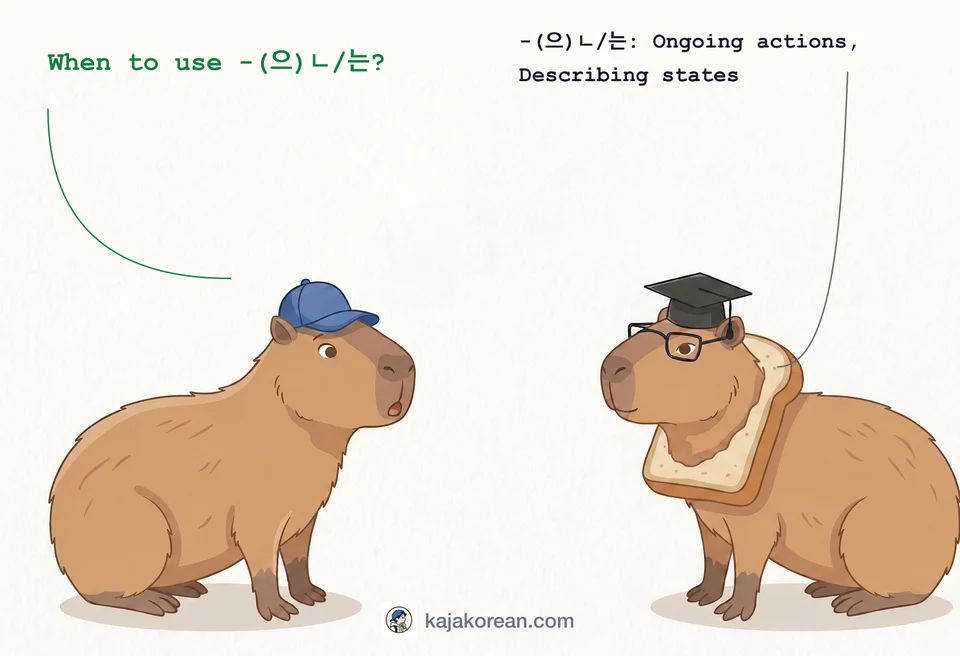
How to use 은/는 in Korean

Pattern: -(으)ㄴ/는

-(으)ㄴ/는 (-(eu)ㄴ, (eu)ㄴ, neun)

-(으)ㄴ/는 is an essential Korean verb ending to express tense and state. Learn how to use it for present, past, and ongoing actions.

Korean verb endings -(으)ㄴ/는 usage guide

Usage guide

When and how native speakers actually use it.

-(으)ㄴ/는(-(eu)ㄴ, (eu)ㄴ, neun)

Verb endings indicating past and present actions or states

When to use

Describing past facts, Ongoing actions, Describing states

The nuance

Use -(으)ㄴ for past tense and -는 for present tense. For past, attach '-은' if verb stem ends with a consonant, '-ㄴ' if it ends with a vowel. For present tense, attach '-는'. Adjectives use past tense endings like '-았/었/였던'.

Real-world examples

  • 내가 어제 먹은 음식이 맛있었어.

    nae-ga eo-je meok-eun eum-sik-i mas-iss-eoss-eo., nae ga eo je meok eun eum sik i mas iss eoss eo.

    '먹다' is a verb with a consonant stem 'ㄱ', so '-은' attaches to form past tense '먹은'.

  • 나는 지금 공부하는 중이야.

    na-neun ji-geum gong-bu-ha-neun jung-i-ya., na neun ji geum gong bu ha neun jung i ya.

    '공부하다' shows an ongoing action, so '-는' is used to form '공부하는'.

  • 그 사람이 만든 케이크는 정말 달았어.

    geu sa-ram-i man-deun ke-i-keu-neun jeong-mal dal-ass-eo., geu sa ram i man deun ke i keu neun jeong mal dal ass eo.

    '만들다' ends with consonant 'ㄹ', so '-은' attaches to form past tense '만든'.

  • 나는 매일 운동하는 사람이야.

    na-neun mae-il un-dong-ha-neun sa-ram-i-ya., na neun mae il un dong ha neun sa ram i ya.

    Attach '-는' for present tense to express habitual action '운동하는'.

  • 그는 어제 온 사람이야.

    geu-neun eo-je on sa-ram-i-ya., geu neun eo je on sa ram i ya.

    '오다' ends with a vowel, so '-ㄴ' attaches to form past tense '온'.

  • 나는 새로 산 책을 읽었어.

    na-neun sae-ro san chaek-eul ik-eoss-eo., na neun sae ro san chaek eul ik eoss eo.

    '사다' ends with vowel, so '-ㄴ' attaches to form past tense '산'.

  • 그녀가 좋아하는 음악을 틀었어요.

    geu-nyeo-ga joh-a-ha-neun eum-ak-eul teul-eoss-eo-yo., geu nyeo ga joh a ha neun eum ak eul teul eoss eo yo.

    Attach '-는' for present tense to express current liking '좋아하는'.

  • 나는 어제 본 영화가 재미있었어.

    na-neun eo-je bon yeong-hwa-ga jae-mi-iss-eoss-eo., na neun eo je bon yeong hwa ga jae mi iss eoss eo.

    '보다' ends with vowel, so '-ㄴ' attaches to form past tense '본'.

Quick quiz

  1. Which sentence correctly uses the past tense form?

    다음 중 과거 시제를 올바르게 사용한 문장은?(da-eumjunggwa-geosi-je-reulol-ba-reu-gesa-yong-hanmun-jang-eun?, daeumjunggwageosijereulolbareugesayonghanmunjangeun?)
  2. Which expression indicates an ongoing action?

    현재 진행 중인 동작을 나타내는 표현은?(hyeon-jaejin-haengjung-indong-jak-eulna-ta-nae-neunpyo-hyeon-eun?, hyeonjaejinhaengjungindongjakeulnatanaeneunpyohyeoneun?)
  3. Which sentence is incorrect?

    다음 중 틀린 문장은?(da-eumjungteul-rinmun-jang-eun?, daeumjungteulrinmunjangeun?)

More usage guides

View all usage guides →